
The Best CMMS Software for Your Organization

The best CMMS isn't the one with the longest feature list. It's the one your technicians actually use to create work orders, document interventions and decide what to repair or replace. A second question now matters just as much: what does artificial intelligence actually do for your team?
The answers vary a lot. Some vendors don't mention AI at all. Others use it to analyze sensor data or forecast which parts to order. Octopus offers an AI Assistant that configures the solution for you, recommends actions and takes over repetitive tasks.
This comparison covers six options: Octopus CMMS, Interal, Fiix, CARL Source, IBM Maximo and MaintainX. Every profile is based on the vendor's official website.
The 6 CMMS software options to compare
The right choice depends on your assets, your maintenance environment and what you expect from AI. Here is an overview.
| Software | Best for | Strengths | AI stated on the official site | Point to check |
|---|---|---|---|---|
| Octopus CMMS | Technical services, healthcare, biomedical engineering, municipalities, education, public sector, SMBs | Work orders generated and assigned automatically, full history per equipment, MTTR and MTBF, no-code platform | AI Assistant: configuration by conversation, proactive recommendations, fewer repetitive tasks | Responsive web portal for technicians, no offline mode stated |
| Interal | Manufacturing, hospitals, municipalities, primary industries, renewable energy | Drag-and-drop planning, MRO inventory, preventive and predictive maintenance, offline mobile app | One mention: IoT equipment availability "using artificial intelligence" | Server location for the optional hosting not stated |
| Fiix | Manufacturing and industrial assets | Offline mobile app, open API, ERP integration, 100+ report templates | AI trend analysis, Fiix AI, parts forecasting | No French-language site found |
| CARL Source | Industry, real estate, transportation, healthcare, local authorities, defense | Versions by sector, offline mobile app (CARL Touch), regulatory inspection reports, GIS, DWG and BIM plans, SaaS or on-premise | CARL AI.Gen generative AI assistant, CARL Predict predictive maintenance, CARL Optim scheduling | Prices on request only, minimum of 10 named users |
| IBM Maximo | Large organizations with critical assets: energy, transportation, manufacturing, government | Enterprise asset management, asset performance, investment planning, field service | Embedded AI: visual inspection, MRO inventory optimization, AI assistant | AppPoints licensing and a large-scale project |
| MaintainX | Manufacturing, facility management, fleets, property management, from small teams to multi-site operations | Mobile-first app, unlimited work orders on every plan, public pricing with a free plan, open REST API | AI procedure generation on every plan, MaintainX Assist on Enterprise | Offline mode and API start at Premium, no on-premise option described |
1. Octopus CMMS: assets, work orders and the AI Assistant
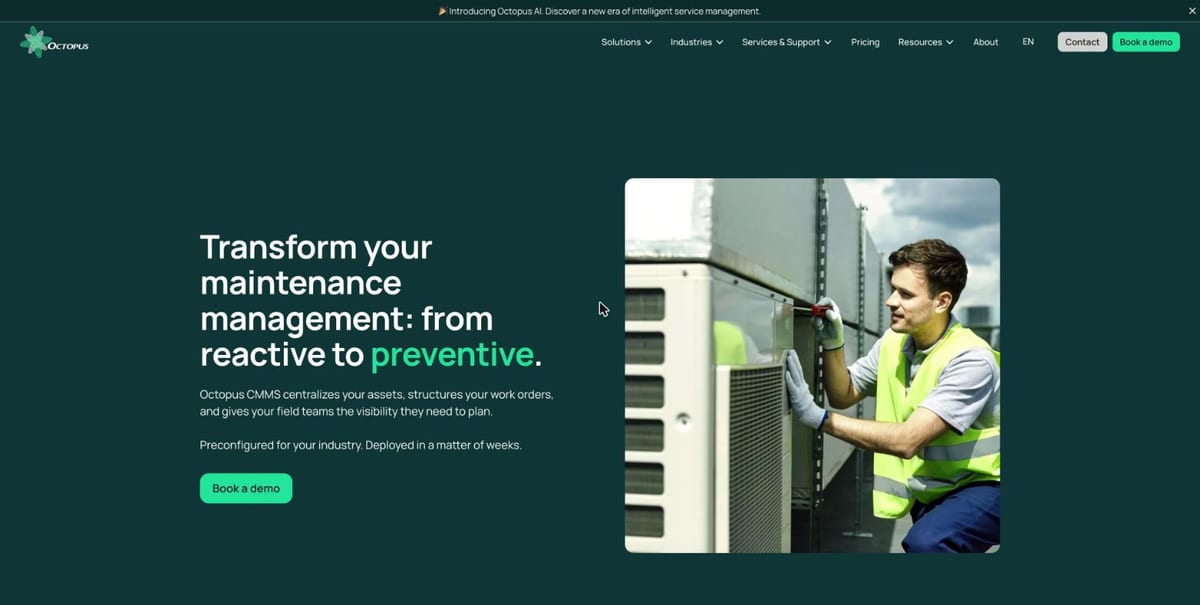
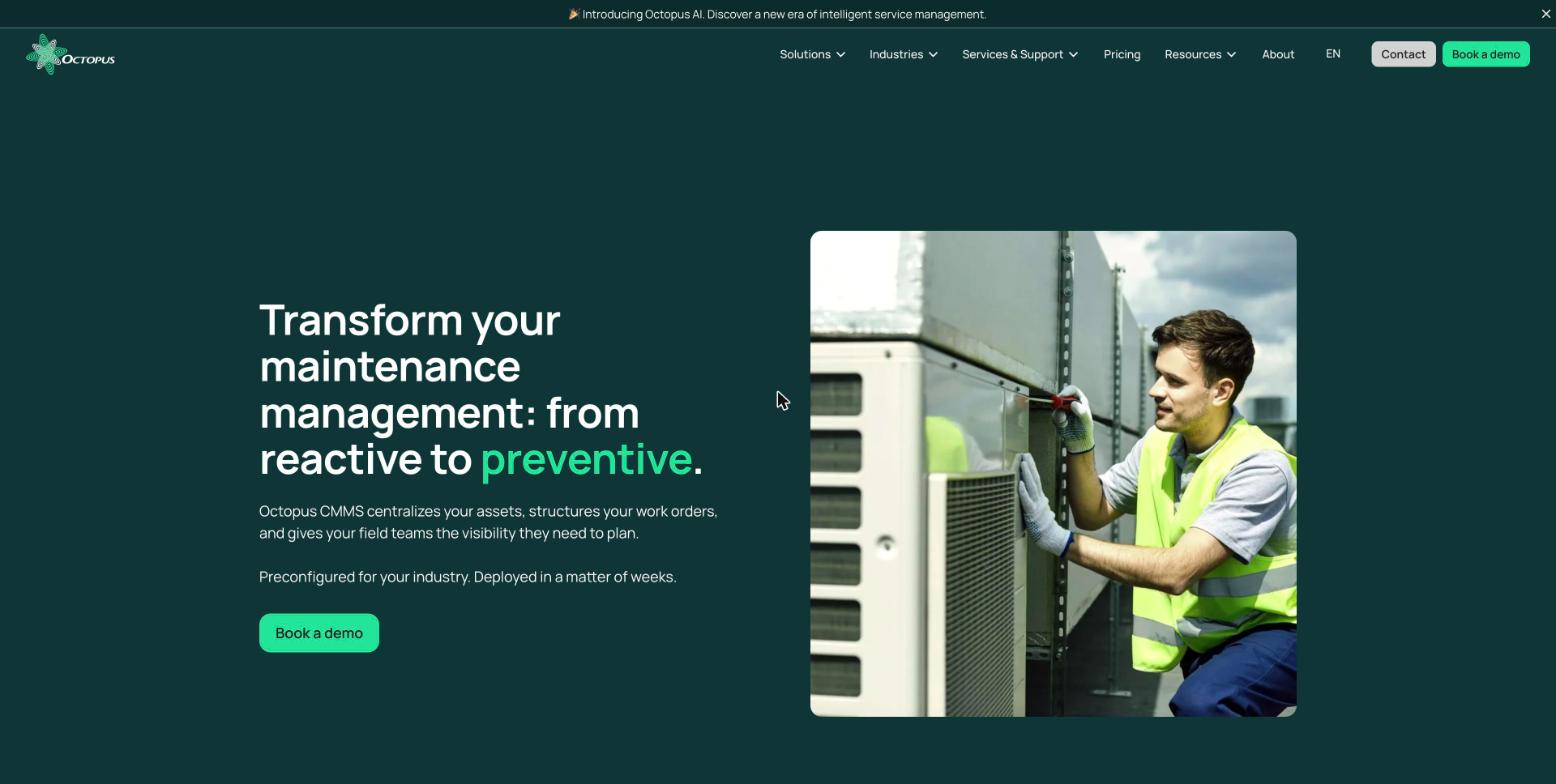
Octopus CMMS centralizes your assets, structures your work orders and gives your field teams the visibility they need to plan. Almost 100 organizations rely on it, according to the Octopus website.
In practice, here is what your team can do:
- Plan preventive maintenance: schedules are automated by equipment, frequency and intervention type.
- Launch and dispatch work: work orders are generated from your maintenance rules, then assigned by technician skills and availability.
- Understand breakdowns: each incident is linked to its equipment, and root cause analysis helps you fix recurring failures instead of just closing work orders.
- Keep the memory of every asset: interventions, breakdowns, replaced parts, costs, manuals, diagrams and procedures all live in the equipment record.
- Decide with numbers: CAPEX and OPEX dashboards, total cost of ownership to choose between repair and replace, and tracking of MTTR (mean time to repair) and MTBF (mean time between failures).
- Work in the field: technicians view and close their work orders in real time from the responsive web portal, on any device.
The platform is no-code: configurable workflows, industry-preconfigured templates and a sandbox. Octopus states that it deploys in a matter of weeks.
The AI Assistant: evolve your CMMS without a developer
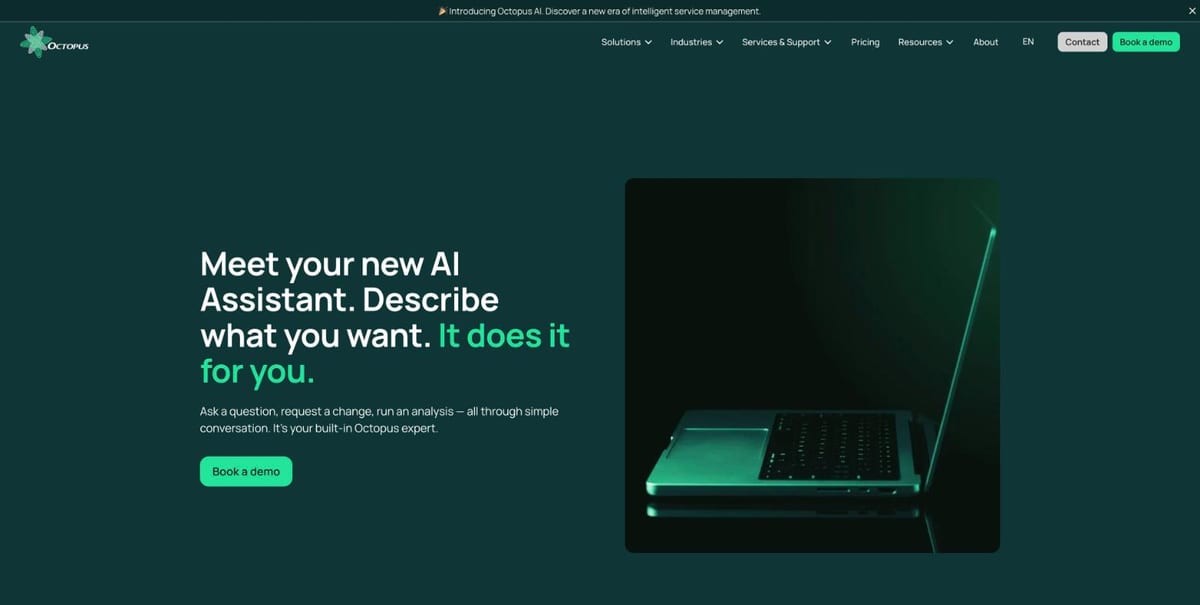
The Octopus AI Assistant is Octopus's key differentiator: you describe what you want, and it does it. A chatbot tells you where to click in menus. The AI Assistant makes the changes itself.
It brings three benefits:
- Configure and evolve the solution on your own. Ask for the field, form or workflow you need: the AI Assistant builds it in real time, with no code, no developer and no outside expert. Your teams adapt their maintenance processes as their needs change, and gain agility and autonomy. It also explains how your configuration works and documents the changes made.
- Get proactive recommendations. It analyzes your maintenance and service data in real time, spots gaps (missing critical fields, inconsistent configurations, incomplete inventories) and proposes concrete actions to manage your equipment better and plan your interventions.
- Spend less time on repetitive tasks. It categorizes and routes requests, assigns interventions and tickets, and detects recurring problems on a piece of equipment. Your teams focus on their priorities.
You can also ask about your tickets, work orders, SLAs, trends, equipment and assets in plain language, the way you would ask a knowledgeable colleague.
Your teams stay in control: the AI Assistant suggests, people decide. Every change, assignment or prioritization can be accepted, adjusted or ignored. No data is retained after the session.
Ask Octopus for a demo of the AI Assistant on your own equipment data.
Sectors, hosting and security
Octopus CMMS comes with preconfigured templates for SMBs, healthcare, municipalities, education and the public sector. For biomedical engineering, Octopus GBM tracks the lifecycle of every medical asset. The same company also offers Octopus ITSM for IT services.
On governance, the platform provides a full audit trail, role-based access and inspection management. It is SOC 2 Type 2 certified, hosted in Quebec, Canada, and compliant with Law 25, with French-speaking technical support.
Best for: technical services, healthcare facilities, biomedical engineering teams, municipalities, educational institutions and public bodies that want a CMMS they can evolve themselves.
Point to check: the CMMS page describes a responsive web portal, not an offline mobile app. If some sites have an unstable connection, test that scenario during the demo.
2. Interal: industrial CMMS with an offline mobile app
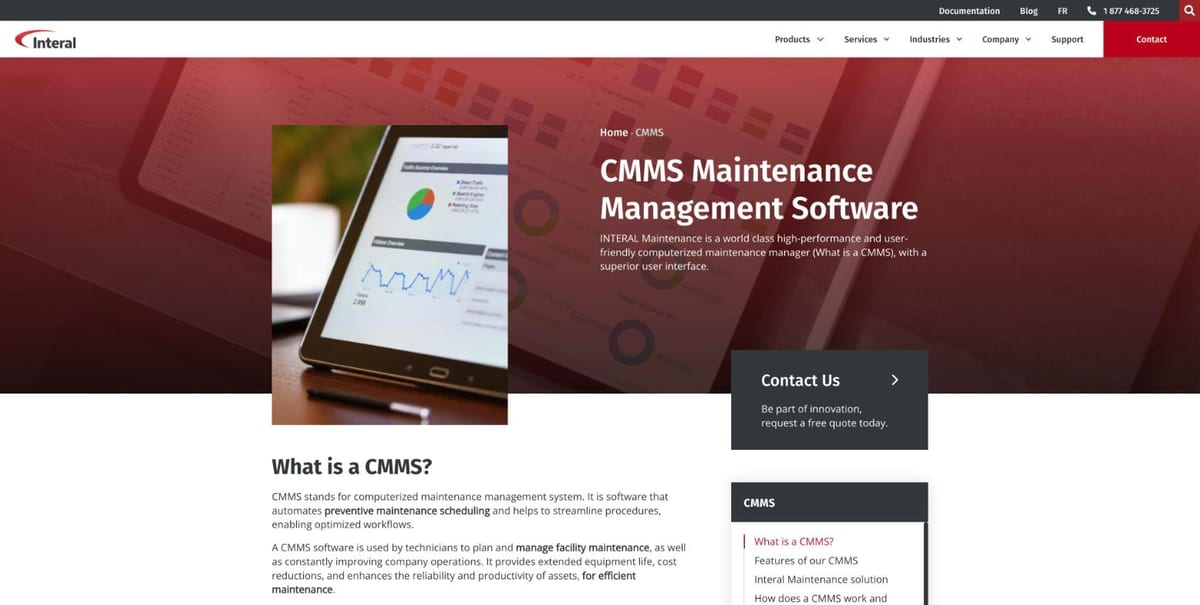
INTERAL Maintenance, by Conception INTERAL Inc., has been around since 1989. The company reports more than 750 clients on 4 continents.
The software covers preventive and predictive maintenance (triggered by time, consumption or events), the asset registry, work orders with material reservations, MRO inventory with automated restocking, and reporting and audit. Planning works by drag and drop, with visual workload balancing by week, day or hour.
In the field, the Kompanion! app runs on iOS and Android, online and offline: work orders, equipment files, inventory, photos, geolocation and timesheets. Interal integrates with ERP systems and mentions integrations with IoT devices and BI tools.
On AI, the site only mentions IoT equipment availability "using artificial intelligence". No AI assistant is described.
Best for: plants, hospitals, office buildings, municipalities, primary industries and renewable energy producers that plan work for field crews.
Point to check: hosting is offered as an option on Interal's servers, but the site doesn't say where they are located. Ask if data residency matters to you.
3. Fiix: industrial maintenance and AI analytics
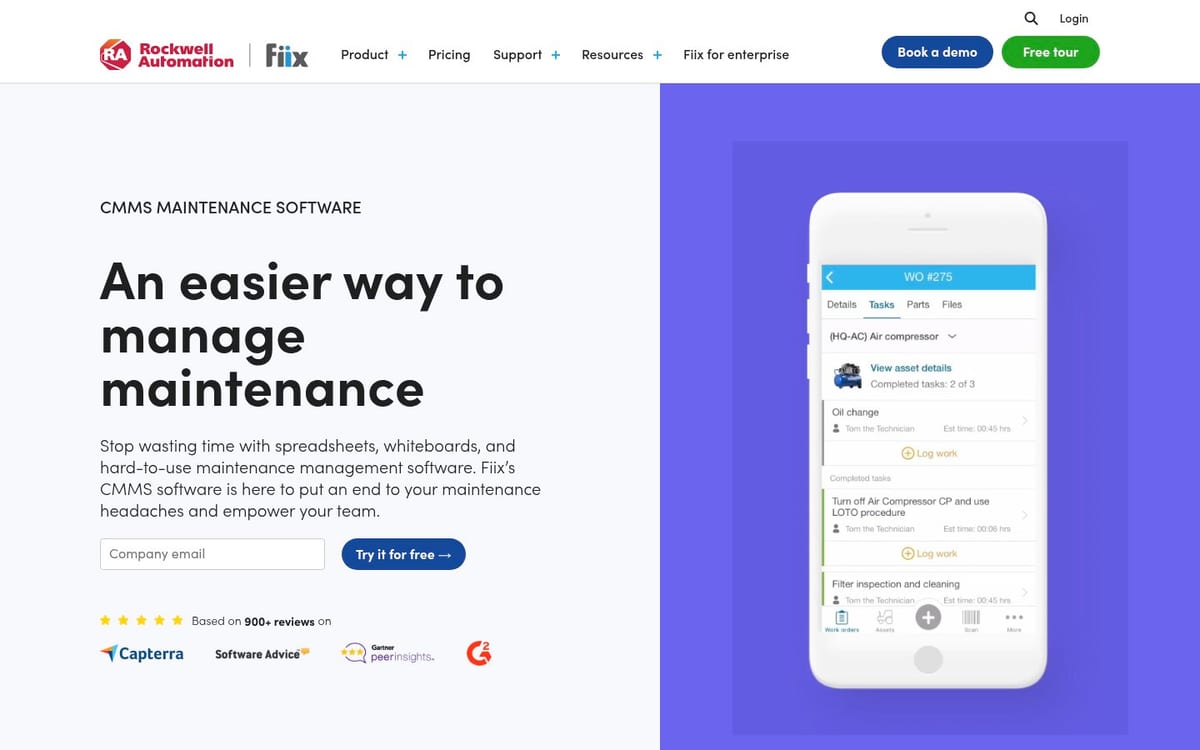
Fiix CMMS, a trademark of Rockwell Automation, states that over 4,100 teams in 100+ countries use its platform.
The mobile app works offline and syncs data as soon as the connection is back. The open API connects the CMMS to other software and hardware, and ERP integration covers parts purchasing and usage. Fiix offers 100+ report templates and condition-based maintenance from production system data.
On AI, Fiix analyzes thousands of work orders, repairs and parts purchases to find trends. Its parts forecaster report predicts which parts to order.
Best for: plants and industrial sites that want to connect work orders to production data, inventory and costs.
Point to check: we found no French version of the site. Check the interface and support language if your technicians work in French.
4. CARL Source: a CMMS and EAM platform with a version for each sector
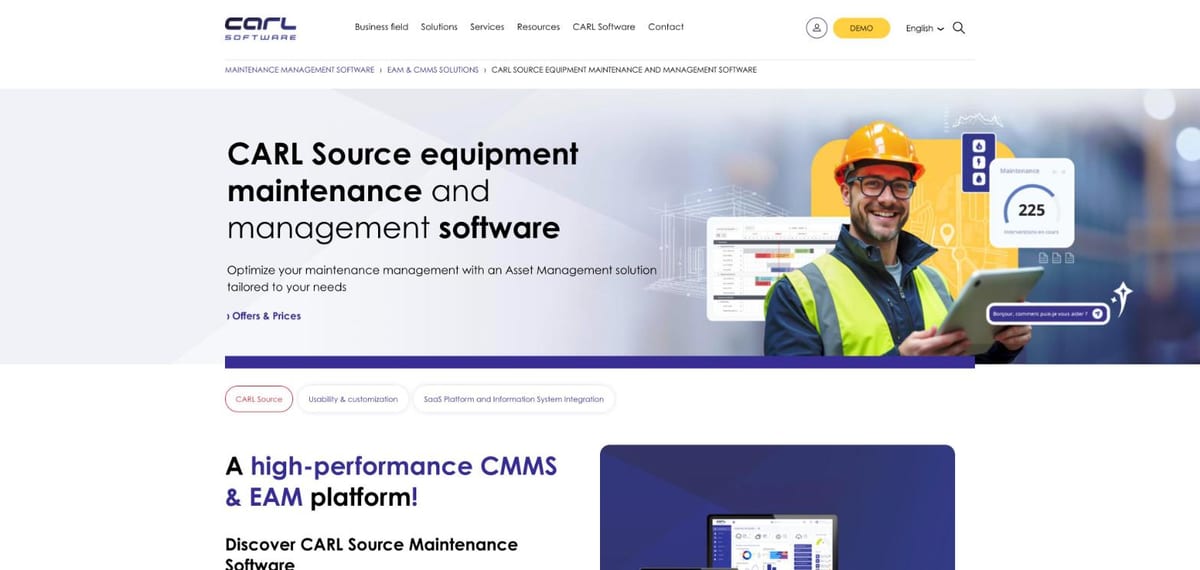
CARL Source is a CMMS and EAM platform from CARL International SAS, based in Limonest, France. The company was founded in 1985 and has been part of the Berger-Levrault group since 2018. CARL states that more than 150,000 daily users track over 10 million pieces of equipment with its software.
The platform covers the equipment register, service requests, work orders, preventive, corrective and predictive maintenance, stock with automatic reordering, purchasing and budget. CARL Control-S imports reports from inspection bodies such as APAVE and Bureau Veritas, and CARL Maps links equipment to GIS, DWG plans and BIM models. The software comes in versions for industry, real estate, transportation, healthcare and local authorities.
In the field, the CARL Touch app works offline and syncs automatically. CARL Source connects to other systems through REST, OData and WebHook APIs, supports LDAP or SSO sign-in, and runs as SaaS or on-premise.
On AI, the site describes CARL AI.Gen, a generative AI assistant built on LLMs that supports users across CARL Source and its mobile apps. CARL Predict handles predictive maintenance from IoT data with machine learning, and CARL Optim generates technicians' route plans from constraints such as skills and machine availability.
Best for: industrial sites, real estate managers, transportation operators, hospitals and local authorities that want a version built for their sector.
Point to check: all four packaged offers (Mars, Neptune, Saturn and Jupiter) are priced on request, and the base offer starts at 10 named users. Ask which offer includes the features you need: GIS mapping and the connection to inspection bodies, for example, are listed in the Jupiter offer.
5. IBM Maximo: enterprise asset management with embedded AI
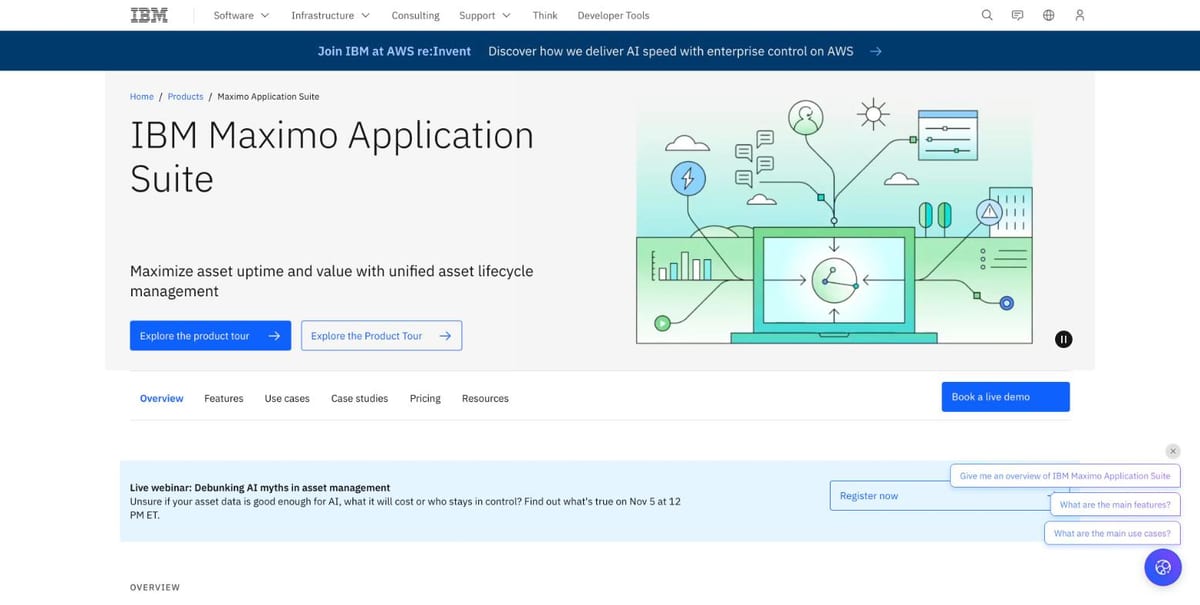
IBM Maximo Application Suite brings maintenance, inspections and reliability together for critical equipment and infrastructure. The suite covers enterprise asset management (EAM), asset performance management (APM), asset investment planning, field service, reliability-centered maintenance and health, safety and environment.
IBM embeds AI across maintenance, field execution, reliability and planning: visual inspection from cameras, drones and mobile devices, MRO inventory optimization and condition-based maintenance from sensor data. IBM's French page also references Maximo's AI assistant.
Maximo runs as client-managed software or SaaS, licensed through a credit system called AppPoints. IBM names Transport for London and Royal Melbourne Hospital among its customers.
Best for: large energy, utility, transportation, manufacturing or government organizations that manage critical assets at scale.
Point to check: the breadth of the suite and the AppPoints model call for precise scoping of the project and licenses.
6. MaintainX: a mobile-first CMMS with public pricing
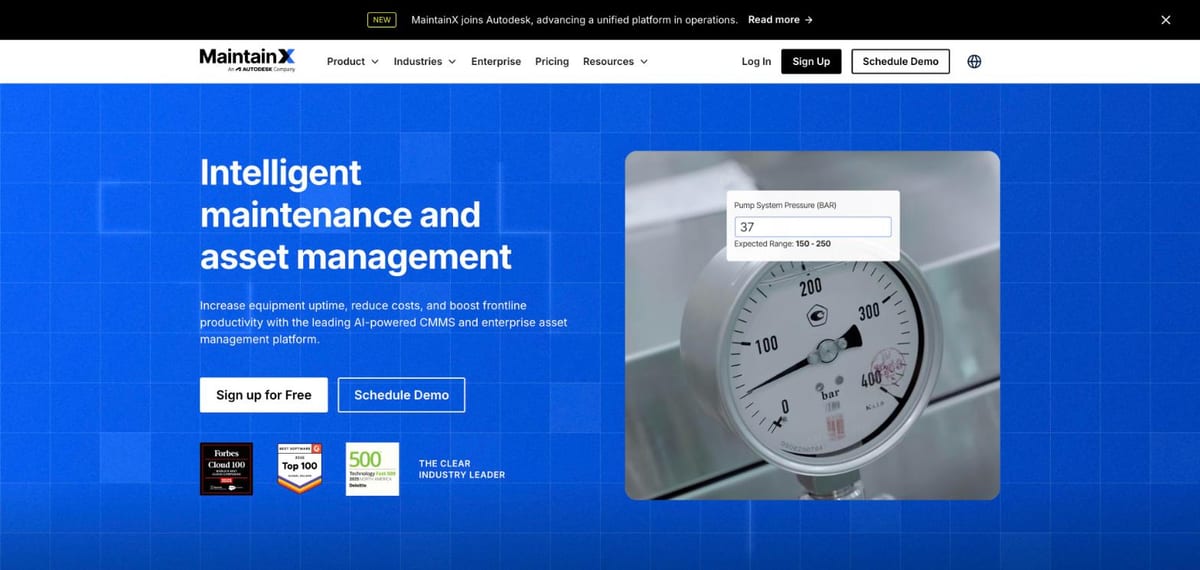
MaintainX describes itself as an AI-powered CMMS and enterprise asset management platform, cloud-based, on web and mobile. Headquartered in San Francisco, the company has been part of Autodesk since August 2026. MaintainX states on its homepage that over 15,000 companies rely on it.
Every plan includes unlimited work orders, procedures with signature capture and inspection checks, and QR and barcode scanning. From the Premium plan, it adds condition-based and meter-based maintenance, asset hierarchies, downtime tracking and parts inventory with purchase orders.
MaintainX presents itself as a mobile-first platform. Offline mode, the open REST API and business integrations (accounting, BI, fleet inspections) start at the Premium plan, and custom ERP integrations such as SAP are listed for Enterprise. The app is available in 29 languages, including French. Pricing is public, in USD: a free Basic plan, then Essential at $20 and Premium at $65 per user per month billed annually.
On AI, AI-powered procedure generation is listed on all four plans. The Enterprise plan adds MaintainX Assist, an AI assistant that helps technicians find asset information, generate procedures and streamline work order reporting, plus AI anomaly detection and reports built from natural language requests.
Best for: maintenance teams in manufacturing, facility management, fleets or property management that want technicians to work from their phones, with a free plan to start.
Point to check: several features, including offline mode and the open API, start at the Premium plan, and MaintainX Assist is listed for Enterprise only. Map each need to a plan before you compare prices.
How do you choose CMMS software?
The best CMMS turns your technicians' real work into reliable data. Evaluate the options in this order.
1. Check the full asset lifecycle
A CMMS should track a piece of equipment from commissioning to retirement. Ask to see the asset record, the equipment hierarchy, technical documents, parts and cost history.
2. Test a real work order
Create a request, assign it, add a priority, attach a procedure, log the time and close the job. If the flow is complicated in a demo, it will be even more so in the field.
3. Compare preventive and corrective maintenance
The software should create recurring tasks, flag overdue work and keep the history. It should also help you analyze recurring failures, not just close them.
4. Measure the available metrics
The most useful ones: MTTR, MTBF, preventive schedule compliance, unplanned downtime, cost per asset and parts consumption. A good dashboard shows a decision to make.
5. Validate the field experience
Technicians should be able to view a work order, add a photo and document an intervention from the device they actually use. Test offline mode if some sites have an unstable connection.
6. Ask what the AI does with your data
Don't settle for the word "AI" on a web page. Ask for a demo on a real case: create a field or a workflow, spot a piece of equipment that keeps failing, assign a request. Also check who makes the final call.
7. Calculate the total project cost
The cost isn't limited to the subscription. Add optional modules, equipment migration, data cleanup, integrations, training and your teams' time.
Which CMMS software should you choose for your situation?
Choose Octopus CMMS if you want to structure your assets and work orders, then evolve the solution yourself with the AI Assistant, without a developer. It is also a consistent choice if you already run your IT services on Octopus ITSM.
Choose Interal if an offline mobile app and planning for industrial crews are your priorities. Choose Fiix for a plant that wants to connect maintenance, parts and production data.
Choose CARL Source if you want a version built for your sector, with regulatory inspections and GIS or BIM plans. Choose IBM Maximo for a large fleet of critical assets. Choose MaintainX if your technicians work mainly from their phones and you want public pricing with a free plan to start.
Summary
All six solutions manage assets, but not in the same way. Interal and Fiix are CMMS tools built for industrial settings. CARL Source comes in versions for industry, real estate, transportation, healthcare and local authorities. Maximo targets large organizations with critical assets. MaintainX is built around its mobile app, with public pricing. Octopus CMMS stands out with its AI Assistant, which lets your teams configure the solution, get recommendations and cut repetitive tasks, while they keep the final say.
CMMS software FAQ
Can AI help manage maintenance?
Yes, but not the same way in every solution. The Octopus AI Assistant configures the CMMS on request, analyzes your data to propose actions, and handles categorization, assignment and recurring issue detection. Your teams keep the final say. IBM Maximo uses AI for visual inspection, MRO inventory and condition-based maintenance. Fiix uses it to find trends and forecast parts. CARL Source describes a generative AI assistant (CARL AI.Gen), predictive maintenance (CARL Predict) and scheduling (CARL Optim). MaintainX generates procedures with AI and lists MaintainX Assist on its Enterprise plan. Interal mentions AI for IoT equipment availability.
Which CMMS should a municipality choose?
Octopus CMMS offers preconfigured templates for municipalities, and Interal lists them among its sectors. CARL Source has a City version for local authorities, and MaintainX lists government among its industries. Validate the workflows for buildings, vehicles, infrastructure and citizen or internal requests.
Which CMMS for a healthcare facility or a biomedical engineering team?
Octopus offers healthcare templates and Octopus GBM for the lifecycle of medical equipment. Interal also lists healthcare among its sectors, CARL Source has a Healthcare version for hospitals, and IBM names Royal Melbourne Hospital as a Maximo customer. Test a medical equipment record, its history and the preventive schedule.
What is the best CMMS for a manufacturing plant?
Fiix, Interal, CARL Source, IBM Maximo and MaintainX all list manufacturing or industry among their sectors. The choice depends on your production systems, your ERP and your condition-based maintenance strategy.
Does CMMS software work on mobile?
Yes, in different ways. Interal (Kompanion!), Fiix and CARL Source (CARL Touch) state that their apps work offline, and MaintainX lists an offline mode on its Premium and Enterprise plans. Octopus CMMS uses a responsive web portal that works on any device. Have two or three technicians test the flow before you choose.
What is the difference between a CMMS and asset management in an ITSM platform?
A CMMS plans and tracks maintenance work: preventive schedules, work orders, technicians, parts, MTTR and MTBF. Asset management in an ITSM platform is mainly used to inventory assets, link them to service requests and track their lifecycle in a CMDB.
Can a CMMS manage multiple sites?
Yes, but multi-site management goes beyond listing several addresses. Check access rights, inventory per site, consolidated dashboards and interventions across sites.
Sources and references
- Octopus CMMS: features, sectors, governance and hosting
- Octopus AI Assistant: benefits and human control
- Octopus pricing: price and included modules
- Interal CMMS: modules, sectors and integrations
- Fiix CMMS: offline mobile, API and AI
- CARL Source: features, mobility, integrations and hosting
- CARL Source pricing: packaged offers and minimum users
- CARL AI solutions: CARL AI.Gen, CARL Predict and CARL Optim
- IBM Maximo Application Suite: suite scope, AI and deployment
- MaintainX: platform, customers and security
- MaintainX pricing: plans, features by plan, AI and integrations
- MaintainX AI: MaintainX Assist
- About MaintainX: Autodesk acquisition
Also to be read
Explore more articles on incident management and ITSM best practices.