
ITSM Software for Large Enterprises: 6 Options

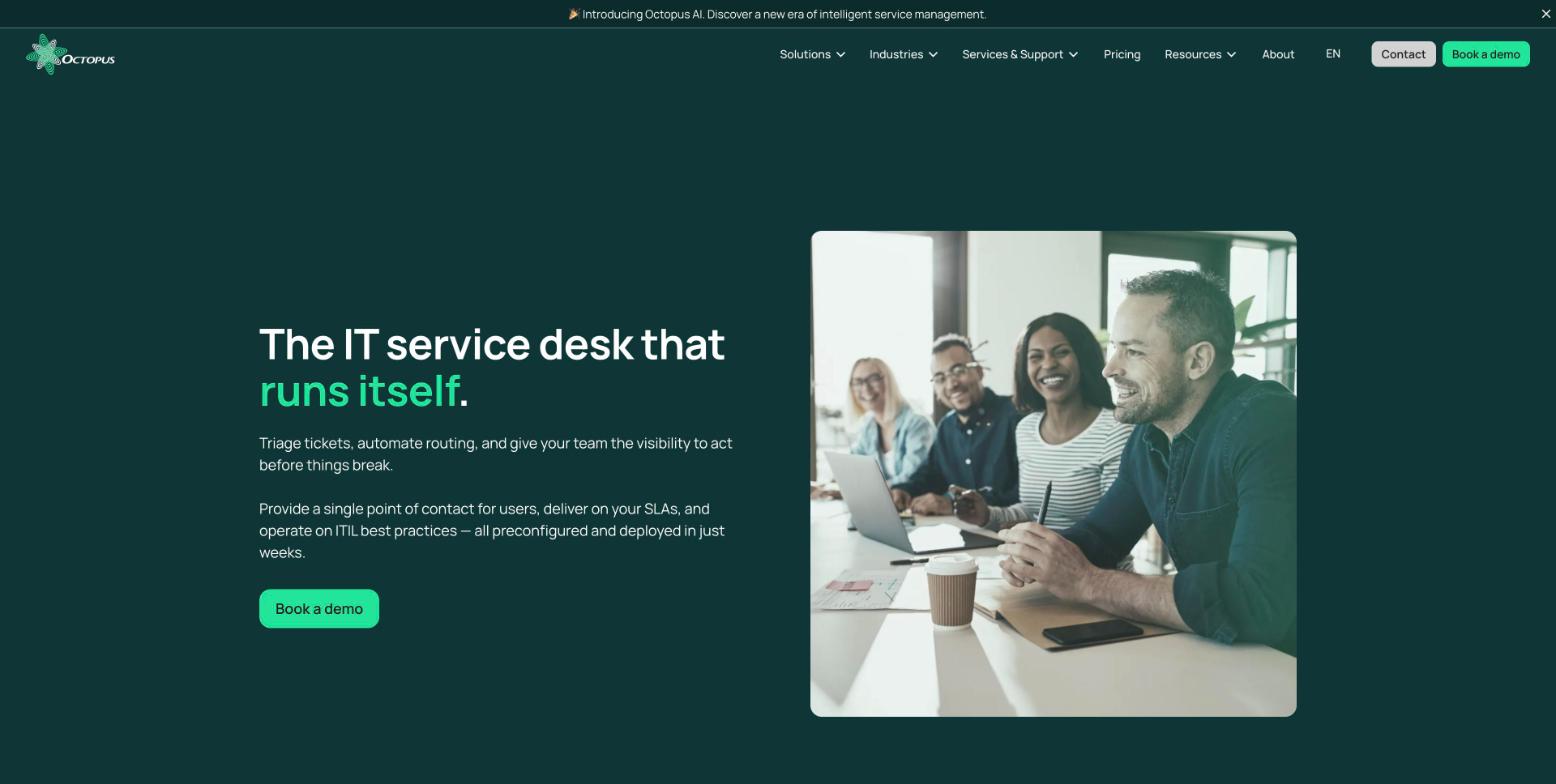
For a large enterprise, the best ITSM software is not the one with the most modules. It is the one that can govern distributed IT services, connect incidents to assets and changes, plug into your digital identity stack and stay manageable as the organization grows.
The shortlist below compares six platforms on five criteria that actually matter at enterprise scale: process depth, CMDB and assets, integrations, deployment and governance. Prices are not compared, because several vendors only quote pricing on request. This keeps an entry price from being mistaken for the real cost of an ITSM program.
ITSM software to consider for a large enterprise
The right choice depends on your operating model. A company that wants a highly configurable global platform will not choose the same tool as an organization that wants its own teams to configure the platform, data hosted in Canada and a French-language portal.
| Software | Enterprise profile | Enterprise-scale strength | Limit to validate |
|---|---|---|---|
| Octopus ITSM | Public sector, healthcare, education and multi-service teams | AI Assistant that configures the platform by conversation, sector-specific preconfiguration, no-code | Validate the integrations specific to your architecture |
| ServiceNow ITSM | Large global organizations and complex environments | Platform depth and a vast ecosystem | Program governance and administration effort |
| Jira Service Management | Companies already using Jira and DevOps practices | Continuity between development, operations and services | Data model and reporting need careful scoping |
| ManageEngine ServiceDesk Plus | Organizations that want several deployment options | Cloud, on-premises, ITAM, CMDB and ESM | Check coverage of advanced needs by edition |
| InvGate Service Management | Teams looking for self-service configuration | No-code workflows, catalog and automation | Check regional coverage and contract requirements |
| BMC Helix ITSM | Companies with a complex multicloud architecture | Orchestration and service management at scale | Configuration complexity and implementation project |
1. Octopus ITSM: structured IT services, configured by your own team with AI
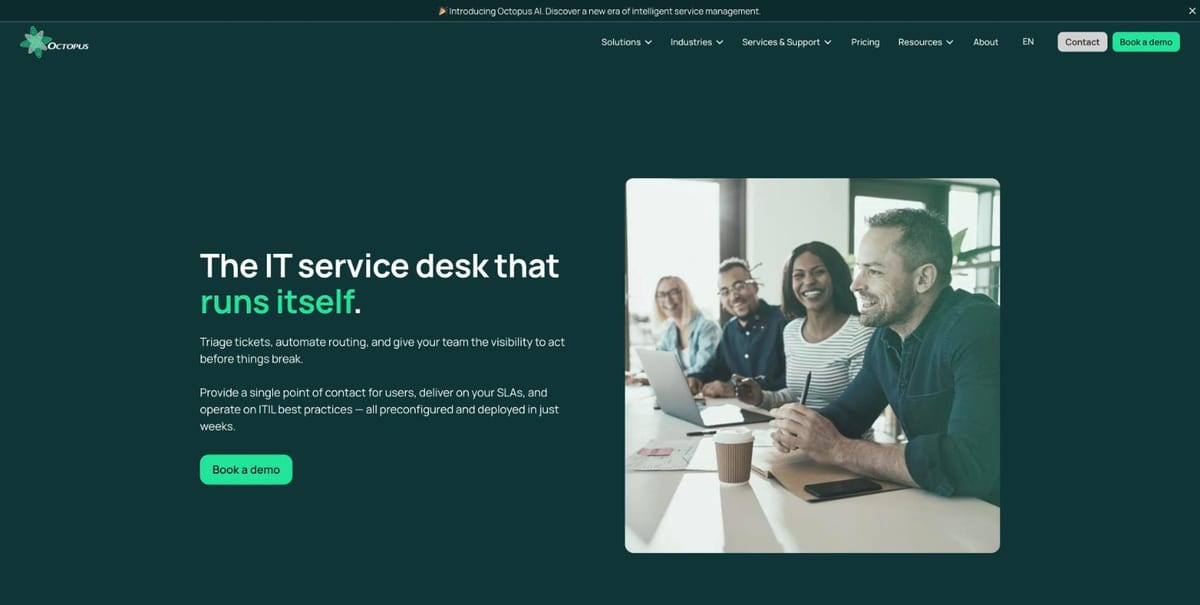
Octopus ITSM suits organizations that want to structure their IT services without starting from a blank environment. The platform covers incidents, requests, problems, changes, approvals, the service catalog, SLAs and the CMDB. It is preconfigured on ITIL best practices, with templates for healthcare, education, municipalities and the public sector, and it can be customized without code.
The AI Assistant as a differentiator. At enterprise scale, the bottleneck is often the backlog of configuration requests waiting on a few administrators. The Octopus AI Assistant addresses that directly:
- Configure and evolve the platform on your own. Describe the field, form or workflow you need and the AI Assistant builds it in real time, using Octopus's native no-code architecture. No developer, no outside expert. It can also explain how your configuration works and document the changes made in a session.
- Proactive recommendations. It analyzes your data in real time, identifies gaps such as missing critical fields, inconsistent configurations or incomplete inventories, and recommends concrete actions.
- Fewer repetitive tasks. It categorizes and routes requests, assigns tickets, detects duplicates and recurring issues, prioritizes by impact and raises SLA alerts.
The AI Assistant proposes; your teams decide whether to accept, adjust or ignore each change. Octopus states that it runs in a fire-and-forget mode, with no data retained after the session.
Octopus says more than 220 organizations rely on Octopus ITSM, which should be read as a figure declared by the vendor. For governance, the platform lists ITIL compliance, an audit trail, role-based access control, SOC 2 Type 2 certification and AD / SSO integration. It is hosted in Quebec, Canada, under Law 25, with French-language support.
Best for: an organization that wants a single point of contact for IT requests, clear governance, administrators who can delegate configuration to an AI Assistant, and a solution that extends to ESM, CMMS or biomedical equipment management.
Limit: large teams need to validate each integration, the security model and identity federation requirements before signing. A feature listed on the product page is no substitute for a test in your own environment.
2. ServiceNow ITSM: platform depth
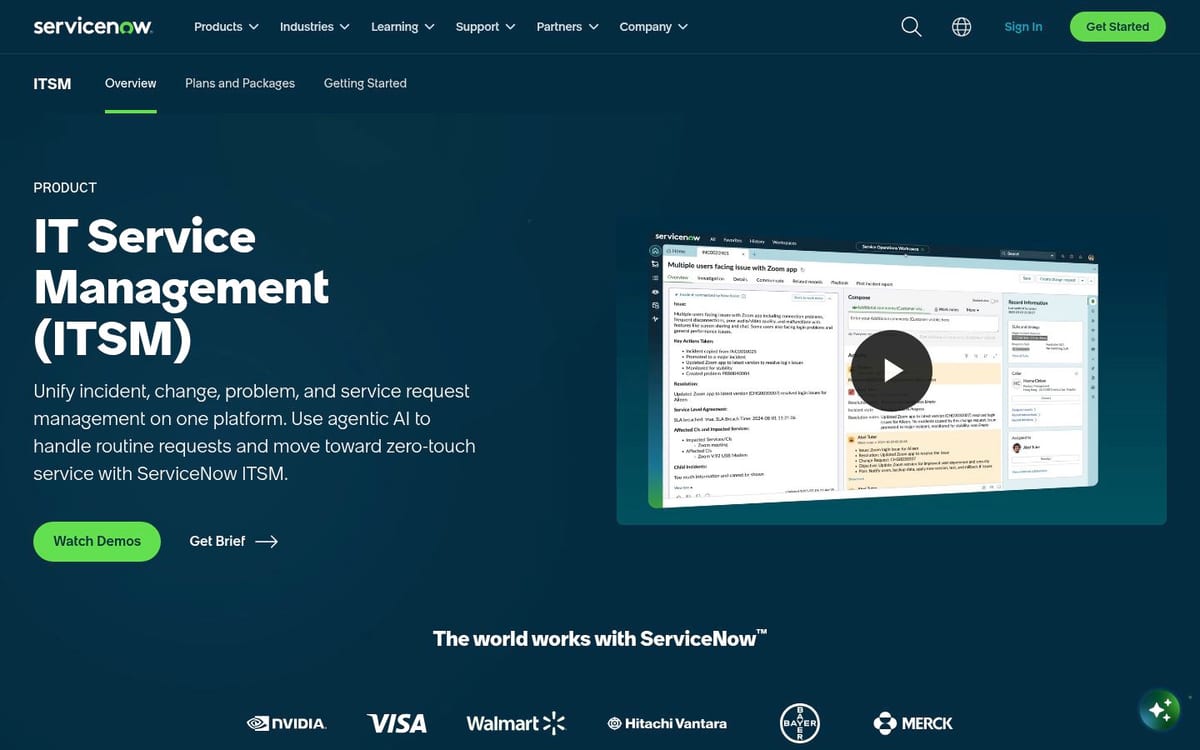
ServiceNow ITSM is built for companies that want ITSM to be a governance platform at global scale. Its value goes beyond the ticket: incidents, changes, problems, assets, knowledge, catalogs and workflows can all sit in one service model.
ServiceNow's strength is its ecosystem. A large enterprise that already has platform teams, governance processes and many integrations can use that depth to standardize several business units.
Best for: an international group with a dedicated platform administration team that wants to connect ITSM with operations, security, HR or customer service.
Limit: the platform demands strong governance. Before buying, define data owners, configuration rules, test environments, integration responsibilities and how you will measure value. ServiceNow does not publish standard prices on its ITSM pricing page, so the quote needs to include modules, users, professional services and support.
3. Jira Service Management: the link between IT and DevOps
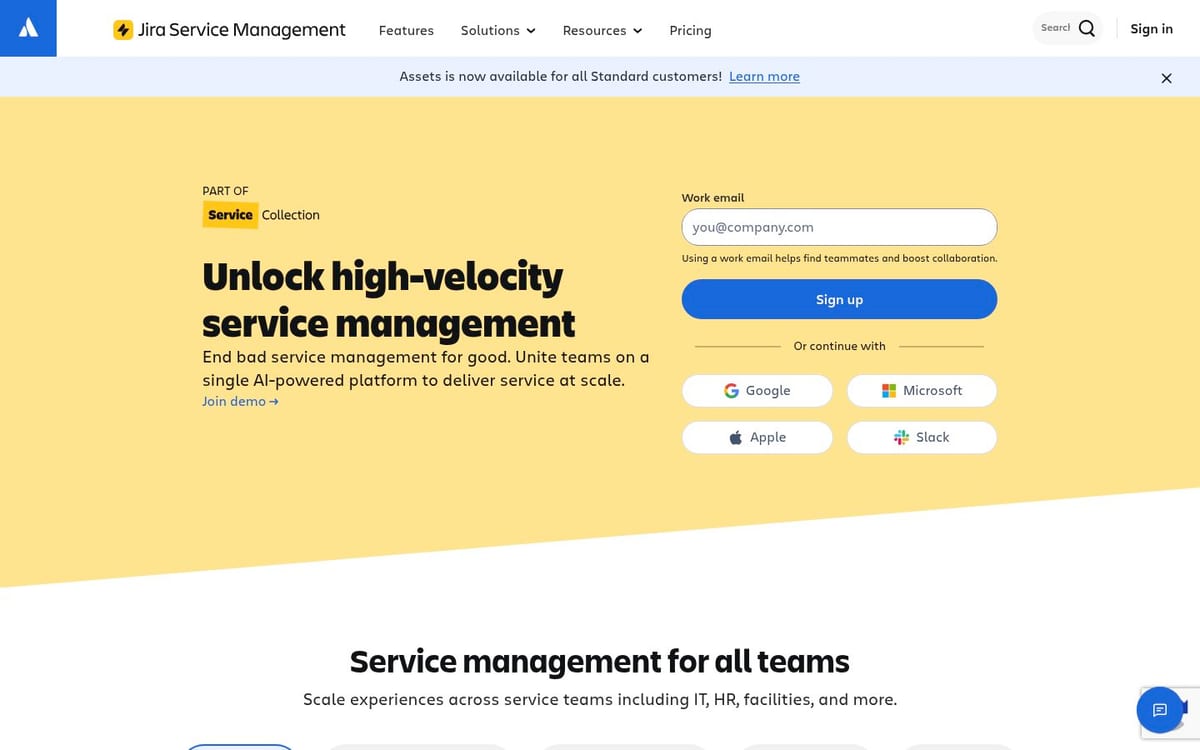
Jira Service Management is a logical choice when development teams already use Jira, Confluence or Bitbucket. Atlassian documents request, incident, problem, change, asset, configuration and knowledge management in its official feature overview.
The value comes from continuity between development work and the service delivered. An incident can be linked to the changes, teams and configuration items involved, which gives operations teams useful context.
Jira Service Management is sold in Free, Standard, Premium and Enterprise cloud plans, according to Atlassian's pricing page. Do not plan a new self-managed deployment: Atlassian stopped selling Data Center to new customers on March 30, 2026, and Data Center reaches end of life on March 28, 2029, according to its Data Center end-of-life page. Large enterprises should check data residency, site management, roles, automation limits and reporting before rolling the platform out widely.
Best for: an organization that wants to close the gap between development, operations and the service desk.
Limit: Jira can become very flexible. Without a shared data model and project conventions, each team risks configuring its own service desk and fragmenting reporting.
4. ManageEngine ServiceDesk Plus: several deployment models
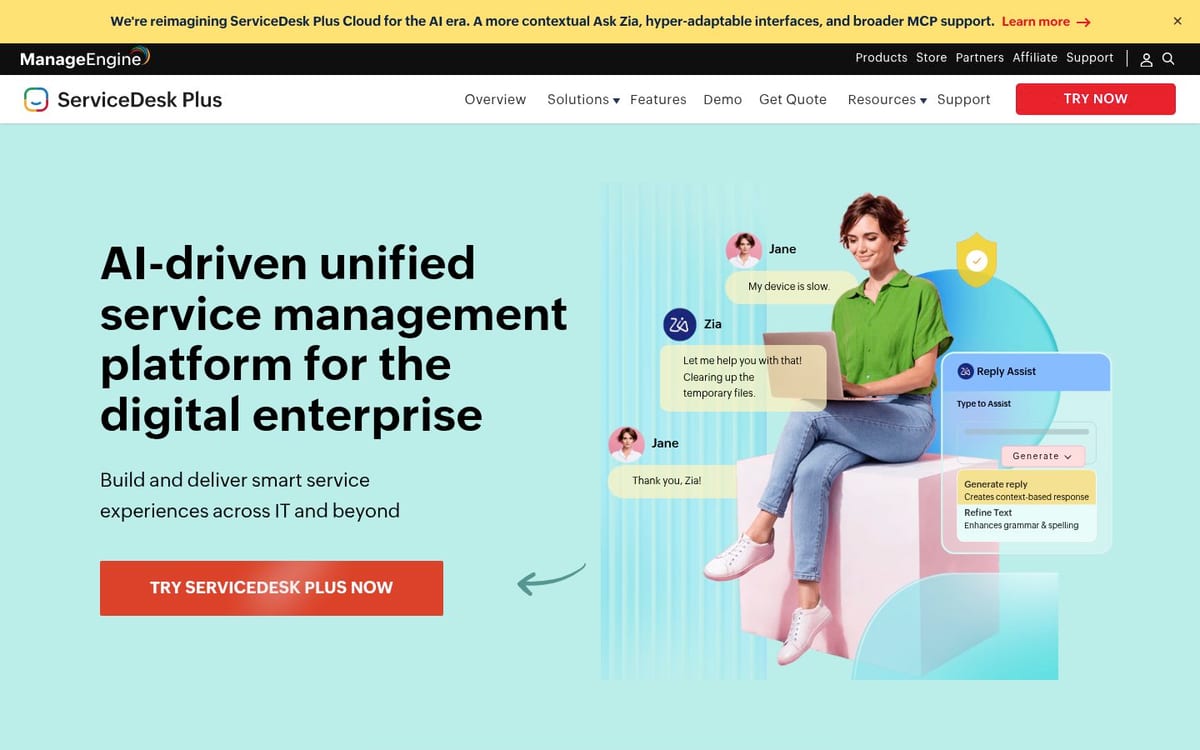
ManageEngine ServiceDesk Plus brings together the service desk, asset management, the CMDB and Enterprise Service Management features. The official page presents cloud and on-premises options, a multi-instance model to separate departments, and low-code customization.
That combination can appeal to a large enterprise that wants to keep part of its infrastructure in-house or already runs several ManageEngine products. The platform also covers approvals, SLAs, dashboards and request workflows.
ManageEngine offers three editions: Standard for the IT service desk, Professional, which adds IT asset management, and Enterprise, the complete ITSM package with key ITIL practices, IT asset management and the CMDB. Each edition is available in the cloud or on premises. Edition and pricing details should be checked on the official pricing page, because the number of assets and the modules affect the cost.
Best for: a company that wants to choose between cloud and on-premises and connect ITSM to a broader IT management ecosystem.
Limit: the number of editions and modules makes the contract scope important. Build a matrix that separates included features, add-on modules and the integrations you need.
5. InvGate Service Management: self-service configuration
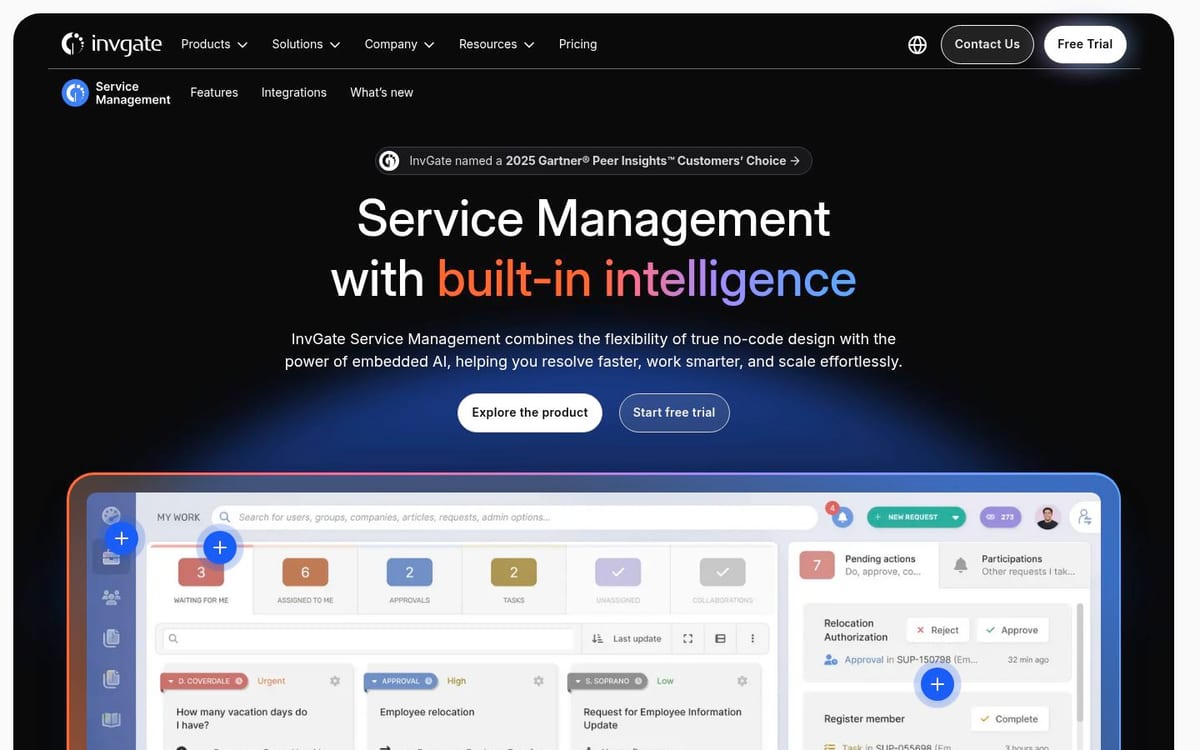
InvGate Service Management targets teams that want to configure their workflows, catalogs, SLAs and automations with little reliance on developers. Its product page covers incident, problem, change, service level, knowledge, multi-department and asset management.
The platform can suit an organization that wants to start with ITSM and then extend the portal to other services. The vendor also provides a security and trust page worth reviewing with your legal, security and architecture teams.
Best for: a company that gives service owners the mandate to evolve workflows themselves.
Limit: configuration autonomy does not replace a shared architecture. Evaluate change controls, admin rights, audit logs and the ability to harmonize practices across regions.
6. BMC Helix ITSM: complex multicloud environments
BMC Helix ITSM deserves a look when the enterprise has to orchestrate services across a multicloud, hybrid or heavily integrated environment. BMC's product page lists incident and problem management, change and release management for hybrid and multicloud environments, a CMDB, knowledge management, a multi-cloud broker and AI agents.
Best for: a large IT department that already runs a complex operations management architecture and needs a platform that can integrate with it.
Limit: the project requires thorough technical and commercial validation. BMC does not publish prices: its site offers a pricing request form, so the quote has to confirm the scope, deployment options and implementation responsibilities.
How to choose ITSM software for a large enterprise
The right decision starts with your service model, not with a product demo. Use these seven questions to narrow the list.
- Who owns the data model? Name the owners of users, services, assets, CMDB relationships, categories and priority levels.
- Which processes must be shared? Separate mandatory practices from what can stay local. A global organization should not create an exception for every team.
- Which integrations are blockers? Test identity, email, Microsoft Teams, monitoring, development tools, assets and HR systems.
- Which deployment is acceptable? Compare cloud, hybrid and on-premises on data residency, continuity, backups and audit requirements.
- Who will administer the platform? Enterprise software needs an operating model, roles and a test environment. If a vendor offers an AI assistant for configuration, test what it can change, who approves it and how changes are logged.
- How will you measure the service? Before the project starts, choose your metrics for backlog, response time, resolution time, SLA compliance, satisfaction and recurring incidents.
- What will the pilot cover? Start with one representative service, a few integrations and frequent requests. Add other business units once adoption and data quality are confirmed.
Which ITSM software to choose for your context
Choose Octopus ITSM if you want your own teams to configure workflows, get proactive recommendations and offload repetitive triage through the AI Assistant, with sector templates, French-language support and an extension to internal services.
Choose ServiceNow if your priority is a highly configurable global platform backed by a dedicated platform team.
Choose Jira Service Management if your teams already work in the Atlassian ecosystem and want to bring development, operations and support closer together.
Choose ManageEngine ServiceDesk Plus if the choice between cloud and on-premises, ITAM and integration with your ManageEngine environment matter a lot.
Choose InvGate if your service owners want to change their workflows without constantly depending on a development project.
Choose BMC Helix ITSM if your multicloud architecture and orchestration needs justify a more demanding enterprise platform.
FAQ
What is the best ITSM software for a large enterprise?
The options to compare are Octopus ITSM, ServiceNow, Jira Service Management, ManageEngine ServiceDesk Plus, InvGate Service Management and BMC Helix ITSM. The best choice depends on your architecture, your administration team, your data requirements and the services you want to govern.
What should enterprise ITSM software handle?
At a minimum, it should handle incidents, requests, problems, changes, SLAs, knowledge, assets and reporting. At enterprise scale, add the CMDB, roles, audit logs, integrations and department separation.
Can an AI assistant reduce ITSM administration work?
It can, if it makes real changes under your control. The Octopus AI Assistant builds fields, forms and workflows from a plain-language request, flags gaps in your configuration and data, and handles categorization, routing and assignment. Every change is proposed and approved by your team. Test it on your own backlog of configuration requests during the pilot.
Does ITSM software need a CMDB?
A CMDB is useful if your teams need to understand the relationships between services, assets and changes. It is not a project to launch without governance: define the sources, the owners and the data that is actually useful before you fill it.
Which ITSM software keeps data hosted in Canada?
Octopus hosts its data in Canada and complies with Law 25, with French-language support. For any vendor, confirm where production data, backups and support access are located.
Should you choose cloud or on-premises ITSM software?
Cloud usually reduces the infrastructure burden, while on-premises can meet architecture or control constraints. The decision should cover data residency, backups, updates, integrations, disaster recovery and security responsibilities.
How do you compare ITSM software before buying?
Shortlist three platforms, then run a pilot with real workflows, real roles and a small group of users. Measure portal adoption, routing quality, handling time, reporting and ease of administration.
Sources and references
- Octopus ITSM: processes, features, governance and declared references.
- Octopus AI Assistant: configuration by conversation, recommendations, repetitive tasks, data handling.
- Octopus pricing: hosting, certifications and French-language support.
- Atlassian, Jira Service Management, pricing and Data Center end of life: features, cloud plans and the end of Data Center sales.
- ManageEngine ServiceDesk Plus and ServiceDesk Plus pricing: editions, deployment and enterprise features.
- InvGate Service Management: workflows, catalog and service management.
- ServiceNow ITSM: official platform overview.
- BMC Helix ITSM: official product overview and capabilities.
Also to be read
Explore more articles on incident management and ITSM best practices.