
ITSM Tools Comparison: 6 Ivanti Alternatives

The strongest Ivanti Neurons for ITSM alternatives for healthcare, education, municipal, and public-service teams are Octopus ITSM, Freshservice, Jira Service Management, ManageEngine ServiceDesk Plus, GLPI, and HaloITSM. The right choice depends less on a feature count than on whether the platform can support French and English users, multi-site operations, asset context, auditable workflows, and a service desk your team can actually adopt. It also depends on how much of the daily configuration and triage work your team can hand to AI.
This ITSM tools comparison focuses on that operating reality. It is a different question from a generic list of enterprise platforms: which option gives a Canadian service team the clearest path away from Ivanti without losing control of requests, incidents, changes, assets, and reporting?
Quick comparison of Ivanti alternatives
The best Ivanti alternative depends on the environment you need to run, not just the tool you want to replace.
| Platform | Strongest fit | What it does well | Limitation to validate |
|---|---|---|---|
| Octopus ITSM | Organizations that want an ITIL service desk their own team can configure and evolve | Preconfigured ITIL workflows, no-code changes, an AI Assistant that configures by conversation and recommends actions, service portal, CMDB, and Canadian hosting | Confirm integrations and migration scope for your environment |
| Freshservice | Teams that want a broad cloud platform with a fast start | ITSM, IT operations, assets, ESM, AI-assisted support, and a marketplace | Confirm data residency, French-language depth, and the cost model for your agent count |
| Jira Service Management | Teams already invested in Jira, Confluence, or Atlassian workflows | Strong DevOps connection, incident response, self-service, AI features, and a large app ecosystem | Confirm the configuration effort and local support model |
| ManageEngine ServiceDesk Plus | Organizations that want cloud or on-premises deployment | ITSM, IT asset management, CMDB, ESM, AI features, and low-code customization | Confirm which edition and deployment model match your governance needs |
| GLPI | Teams that value open-source flexibility and asset visibility | Help desk, CMDB, inventory, financial management, plugins, and integrations | Plan ownership for hosting, upgrades, support, and customization |
| HaloITSM | Organizations looking for an all-inclusive ITSM platform | ITIL-aligned workflows, AI, service catalogue, CMDB, change control, and ESM | Confirm Canadian hosting, French-language coverage, and implementation resources |
Vendor pages change often. Ask each provider for a current quote, deployment terms, data-residency details, and a demonstration using your own service catalogue before you decide.
1. Octopus ITSM: an ITIL service desk with an AI Assistant
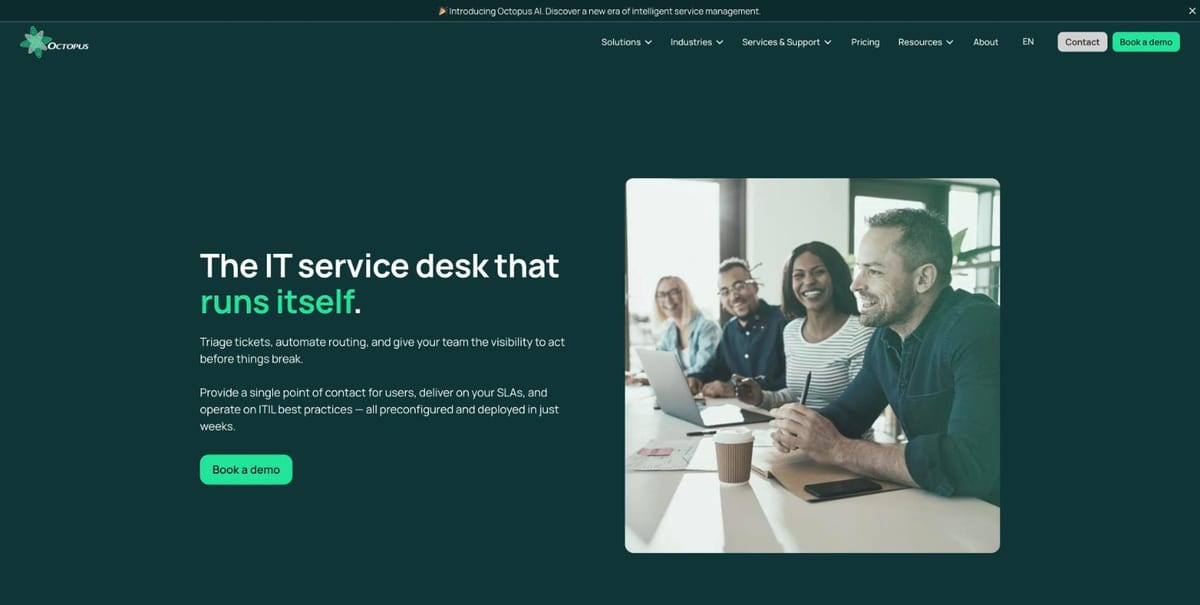
Octopus ITSM is a strong first option for organizations that want ITIL service management they can configure and evolve without developers. Octopus says more than 220 organizations rely on Octopus ITSM to run their internal services. Its product page describes incident, service request, problem, change, and approval management, a self-service portal with a service catalogue and knowledge base, CMDB and IT asset management, automatic escalation before an SLA breach, AI-powered classification, a mobile app, and no-code configuration.
The AI Assistant: what sets Octopus apart
The Octopus AI Assistant is the main reason Octopus comes first in this list. You describe what you want in plain language, and it makes the change or runs the analysis itself, instead of telling you where to click. Octopus puts forward three benefits:
- Configure and evolve the platform on your own. Ask for the field, form, or workflow you need and the AI Assistant builds it in real time, with no code, no developer, and no outside consultant. Your team adapts its service processes as needs change.
- Proactive recommendations. It analyzes your service data in real time, spots gaps such as missing critical fields or incomplete inventories, and proposes concrete actions on a ticket or asset record.
- Fewer repetitive tasks. It categorizes and routes requests, assigns tickets, and detects duplicates and recurring issues, so agents spend their time on priority work.
Your team stays in control. The AI Assistant proposes changes, assignments, and priorities, and people accept, adjust, or ignore them. Ask to see it on your own tickets in the demo.
Octopus serves healthcare, education, municipalities, the public sector, and SMBs. For organizations with French-speaking users or strict privacy obligations, Octopus offers French-language technical support and hosts its cloud in Quebec, Canada, with SOC 2 Type 2 certification and Law 25 compliance.
- Best for: Organizations replacing Ivanti that want an ITIL service desk their own team can configure, with AI that cuts manual triage.
- Pricing: Octopus publishes a price of $95 per active agent per month, with an unlimited end-user portal. Ask whether implementation and training are part of your quote.
- Limitation: Confirm integrations (Octopus lists an open REST API, webhooks, Microsoft 365 and Teams, and AD/SSO), migration work, and the exact scope of each module for your environment.
Octopus is also broader than a service desk. The same product family covers ITSM, CMMS, biomedical equipment management, and ESM. That matters when IT, facilities, biomedical engineering, or HR requests need one governed entry point.
2. Freshservice: a broad cloud alternative
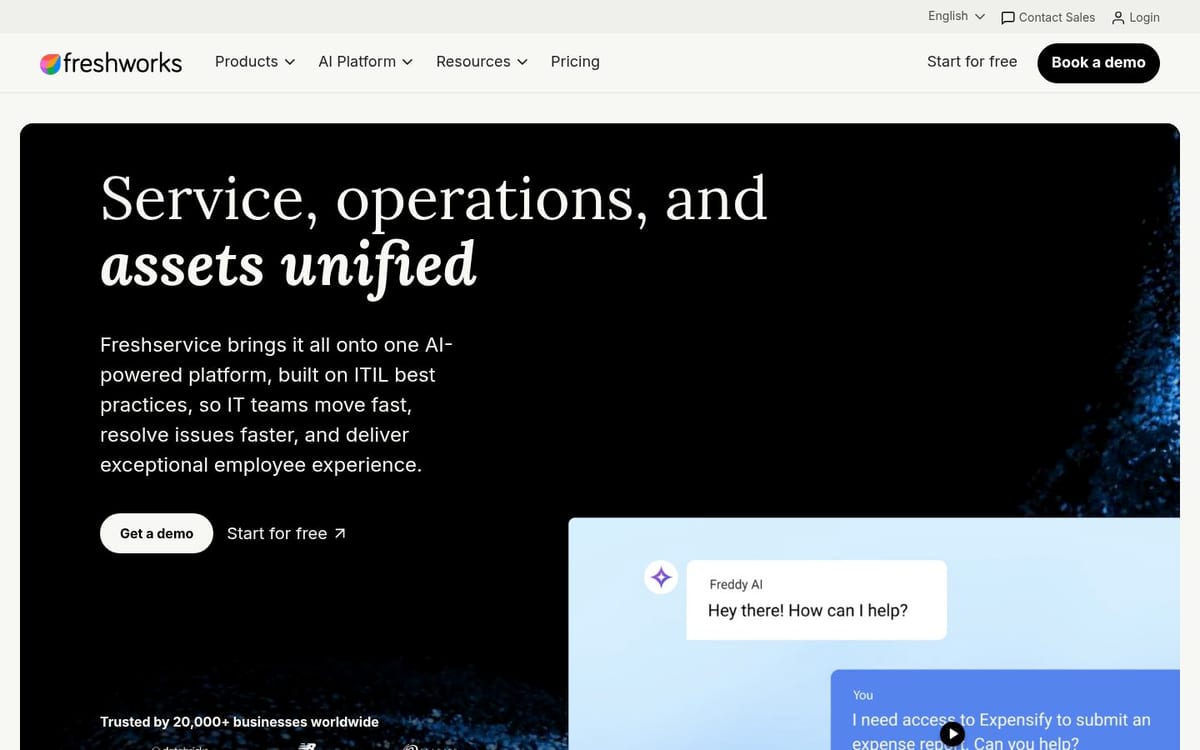
Freshservice is a strong candidate for teams that want cloud ITSM, IT operations, asset management, and enterprise service management in one platform. Freshworks says more than 20,000 businesses use Freshservice worldwide. Its official page also promotes AI features, intelligent routing, a service catalogue, dependency mapping, and integrations through the Freshworks Marketplace.
Freshservice fits a buyer who wants a polished cloud experience and a wide set of connected service operations. Its site claims that 80% of customers go live in under 90 days, but treat that as a vendor-reported benchmark, not a promise for your Ivanti migration.
- Best for: Cloud-first teams that want ITSM and adjacent employee services with a large integration marketplace.
- Pricing: The public product page sends buyers to a demo or trial flow. Get a current quote based on agents, assets, AI features, and service desks.
- Limitation: Buyers with French-speaking users should verify French-language workflows, Canadian data residency, support coverage, and the total cost as more departments and agents join.
Freshservice is worth shortlisting when speed and breadth matter. It is less convincing if your selection depends on a local implementation partner or strict data-residency requirements that the sales process cannot document clearly.
3. Jira Service Management: the DevOps-connected choice
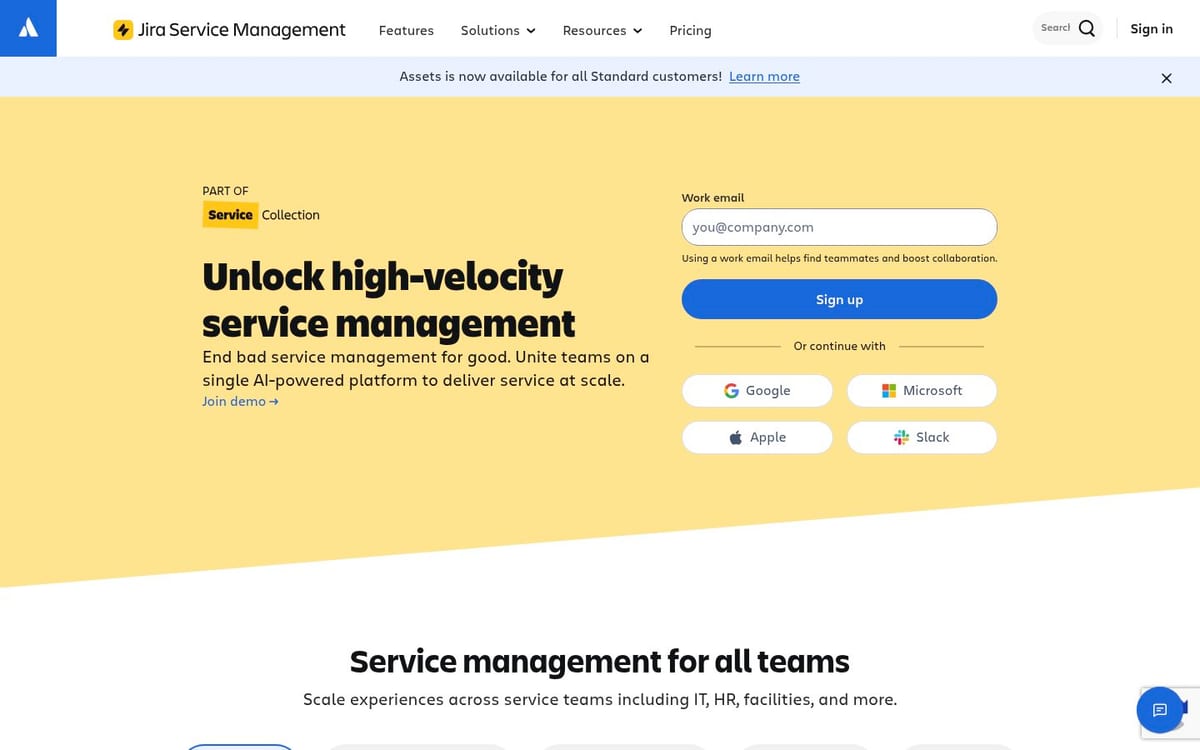
Jira Service Management works best when development, operations, and service management already share the Atlassian ecosystem. Atlassian positions it for IT support, engineering support, employee support, IT operations, and HR service. Its official page says more than 60,000 customers trust Jira Service Management and describes an Atlassian Marketplace with more than 1,000 applications and integrations.
That ecosystem can be a real advantage over Ivanti for a technology organization. Incidents can connect to engineering work, change requests can sit near delivery work, and responders can use shared context instead of copying information between systems.
- Best for: Technology teams that already use Jira and need service management linked closely to DevOps and engineering work.
- Pricing: Atlassian publishes plans through its Service Collection pricing flow. Confirm the current Canadian price, user tier, and any AI or premium requirements before comparing total cost.
- Limitation: Teams outside the Atlassian ecosystem may need more configuration, governance, and training than the product page suggests.
Jira Service Management is not automatically the best fit for a hospital, school service centre, or municipality. Its strength is connected technical work. If your priority is a sector-ready service model for many non-technical users, score it on adoption and administration rather than integration volume alone.
4. ManageEngine ServiceDesk Plus: deployment choice and breadth
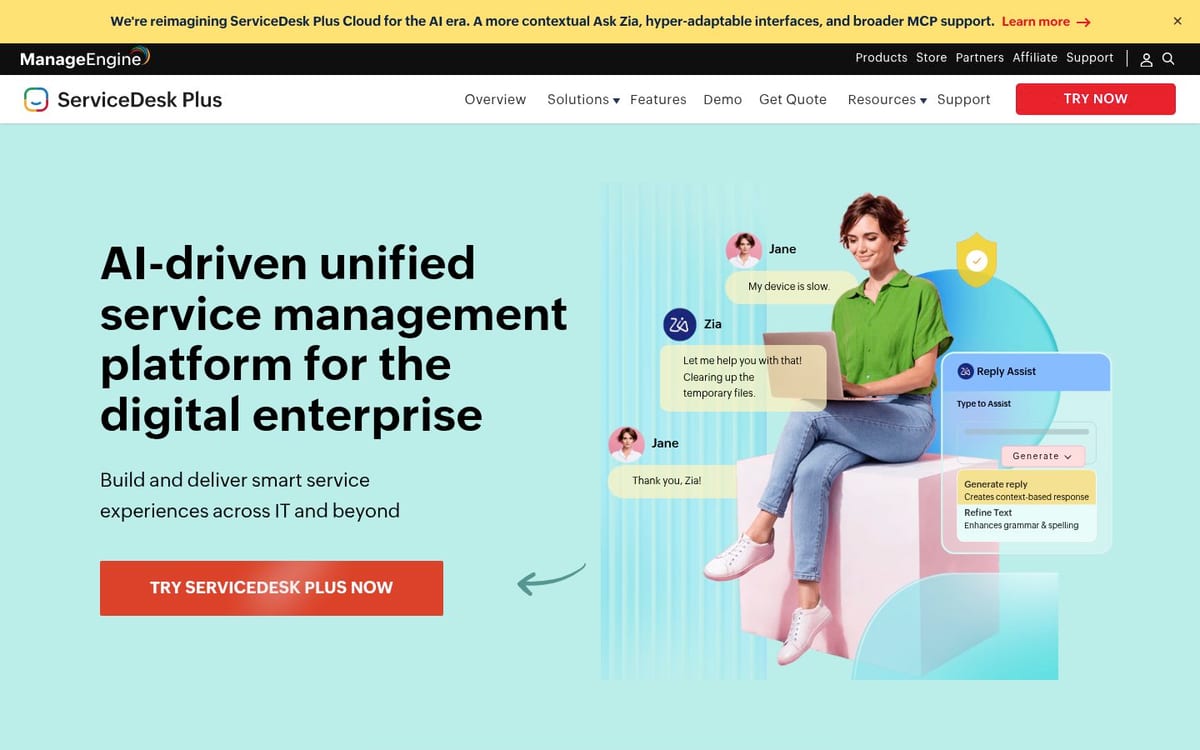
ManageEngine ServiceDesk Plus is a practical Ivanti alternative for organizations that want a wide IT management portfolio and a choice between cloud and on-premises deployment. ManageEngine describes ITSM, IT asset management, CMDB, ESM, low-code customization, AI-assisted triage, and multiple editions from Standard through Enterprise.
The deployment choice can matter to public-sector, healthcare, and education buyers with specific governance requirements. The product also supports teams that want to start with service desk work and expand into assets, changes, problems, releases, or other departments.
- Best for: Organizations that need broad service management with cloud or on-premises options and a large IT management ecosystem.
- Pricing: ManageEngine publishes edition and pricing pages, but the final comparison depends on users, assets, deployment, and add-ons. Request a quote tied to your current Ivanti scope.
- Limitation: The breadth can create administration work. Confirm who will own configuration, upgrades, integrations, and reporting after launch.
ServiceDesk Plus is a useful choice when deployment control is as important as user experience. It needs a careful proof of concept if your team has limited time for platform administration.
5. GLPI: open-source flexibility and asset context
GLPI is an open-source option with help desk, inventory, CMDB, financial management, plugins, and integrations. GLPI’s official site says it has millions of users worldwide and promotes a 45-day free period for a cloud instance. That makes it attractive to teams that want control over the platform and a strong link between tickets and infrastructure data.
GLPI can be a sensible Ivanti alternative when your internal team has the skills to own the operating model. Its flexibility gives you room to shape the platform, but that freedom becomes a responsibility for hosting, upgrades, security review, plugins, documentation, and support.
- Best for: Technical teams that value open-source control, inventory depth, and the ability to shape their service environment.
- Pricing: GLPI publishes cloud and pricing information on its website. Separate subscription cost from the internal cost of hosting, administration, support, and customization.
- Limitation: Open-source flexibility is not the same as low total effort. Assign a clear owner before you select it.
GLPI should be scored highly for asset visibility and extensibility. It should be scored carefully for French and English user experience, vendor accountability, and the level of managed support your organization expects.
6. HaloITSM: an all-inclusive service platform

HaloITSM is an all-inclusive platform covering incident management, service catalogue, change control, CMDB, asset management, integrations, AI, and enterprise service management. HaloITSM says more than 100,000 users across more than 75 countries trust its platform.
HaloITSM is a credible alternative for organizations that want a large feature set without splitting service management across several products. Its public site also describes a 30-day free trial and features included as standard at no extra cost, but confirm current commercial and contractual terms for your region.
- Best for: Organizations that want broad ITIL-aligned capabilities, AI, and ESM in one product.
- Pricing: HaloITSM promotes a free trial and demo rather than a simple public price on its homepage. Ask for a Canadian quote and implementation plan.
- Limitation: A global platform may not match your organization’s language, hosting, procurement, or support requirements without additional validation.
HaloITSM is a good comparison point when your team wants a single platform with a mature feature set. It should not win on feature volume alone. Test the user portal, administration experience, reporting, and support model with the people who will use them every day.
How to choose an Ivanti Neurons alternative
Choose the platform that reduces operational risk during and after the replacement, not the platform with the longest feature list. If your team wants to configure the service desk itself and spend less time on triage, start with Octopus ITSM and its AI Assistant. If your work already lives in Atlassian, cloud-first tooling, or open source, Jira Service Management, Freshservice, ManageEngine, GLPI, and HaloITSM each have a clear case.
1. Map the services before the tickets
List your incident categories, service requests, approvals, SLAs, escalation rules, assets, and reporting needs. Include the workflows used by healthcare, education, municipal, or other departments outside central IT. A migration that copies ticket fields but loses service logic is not a successful replacement.
2. Test the portal with real users
Ask employees to submit common requests in both official languages if that reflects your organization. Check whether the form captures enough context, routes the request correctly, shows status clearly, and helps users find knowledge without calling the service desk.
3. Score data location and governance
Ask where production data, backups, logs, and support access are located. Review role-based access, audit trails, retention, export, identity integration, and incident notification terms. For public-sector and healthcare teams, these questions should be answered in writing before procurement.
4. Run a migration rehearsal
Migrate a representative set of incidents, requests, knowledge articles, users, assets, and relationships. Check search, history, attachments, permissions, and reporting. Your team should know what will move, what will be archived, and what will be rebuilt.
5. Test what the AI actually does
Ask each vendor to show its AI on your own data: classify ten real tickets, suggest an assignment, and add a field to a request form. The Octopus AI Assistant builds fields, forms, and workflows by conversation and proposes actions your team approves. Freshservice, Jira Service Management, ManageEngine, and HaloITSM promote AI features; check which ones are included in the plan you are quoted.
6. Measure adoption after launch
Track portal usage, incomplete requests, routing corrections, SLA breaches, self-service success, reopened incidents, and user satisfaction. These measures tell you whether the new platform improved service delivery or only changed the ticket screen.
Bottom line
Every option here can log tickets. The real difference is who keeps the platform up to date after go-live and how much triage your agents still do by hand. Octopus ITSM answers both with its AI Assistant: your team asks for a field, form, or workflow and gets it without a developer, receives recommendations drawn from its own service data, and hands off categorization, routing, and duplicate detection. People approve every change.
Ask Octopus to demo the AI Assistant. Then run the same demo script with Octopus and any other finalist before you sign.
FAQ
What are the best Ivanti Neurons for ITSM alternatives?
The main alternatives in this comparison are Octopus ITSM, Freshservice, Jira Service Management, ManageEngine ServiceDesk Plus, GLPI, and HaloITSM. Compare them on workflows, AI, language, data location, sector fit, and support, not on feature count alone.
What does the Octopus AI Assistant do in an ITSM tool?
The Octopus AI Assistant configures Octopus by conversation: you ask for a field, form, or workflow and it builds it, with no developer. It also analyzes service data to flag gaps and recommend actions, and it categorizes, routes, and assigns requests and detects recurring issues. People stay in control of every change.
Which Ivanti alternative is best for an organization with French-speaking users?
Octopus ITSM is the clearest starting point if you want French-language support, Canadian hosting, ITIL workflows, and no-code configuration that your own team can drive with the AI Assistant. You still need to validate integrations, migration scope, and the commercial proposal against your own environment.
What is the best ITSM software for healthcare teams?
Healthcare teams need an ITSM platform that connects incidents to assets, locations, approvals, service levels, and audit history. Octopus ITSM, ManageEngine ServiceDesk Plus, Freshservice, and HaloITSM are reasonable candidates, but the final choice should come from a proof of concept using real clinical and technical workflows.
Is Jira Service Management a good Ivanti replacement?
Jira Service Management is a strong replacement when development, operations, and service management already work in Atlassian tools. It is a weaker fit when the main challenge is a sector-specific portal for many non-technical users and the organization lacks time for configuration and governance.
Is GLPI suitable for enterprise service management?
GLPI can support help desk, asset, CMDB, financial, and plugin-based workflows, so it can form part of an enterprise service model. Its suitability depends on whether your team can take responsibility for hosting, upgrades, support, security, and customization.
How should I compare ITSM software alternatives?
Compare service workflows, portal adoption, asset context, AI capabilities, integrations, reporting, identity, data residency, support, migration effort, and total ownership cost. Ask every vendor to demonstrate the same five real requests and one major incident so the results are comparable.
Sources & References
- Octopus ITSM: ITSM capabilities, Canadian hosting, and service workflows
- Octopus AI Assistant: AI Assistant benefits and human control
- Octopus pricing: price per active agent, hosting, and French-language support
- Freshservice: product scope and vendor-reported customer metrics
- Jira Service Management: service teams, customer count, and marketplace scope
- ManageEngine ServiceDesk Plus: editions, deployment, and ITSM capabilities
- GLPI: open-source service management, inventory, and cloud offer
- HaloITSM: ITIL-aligned features, AI, users, and trial information
Also to be read
Explore more articles on incident management and ITSM best practices.