
Freshservice Alternatives: 5 Options

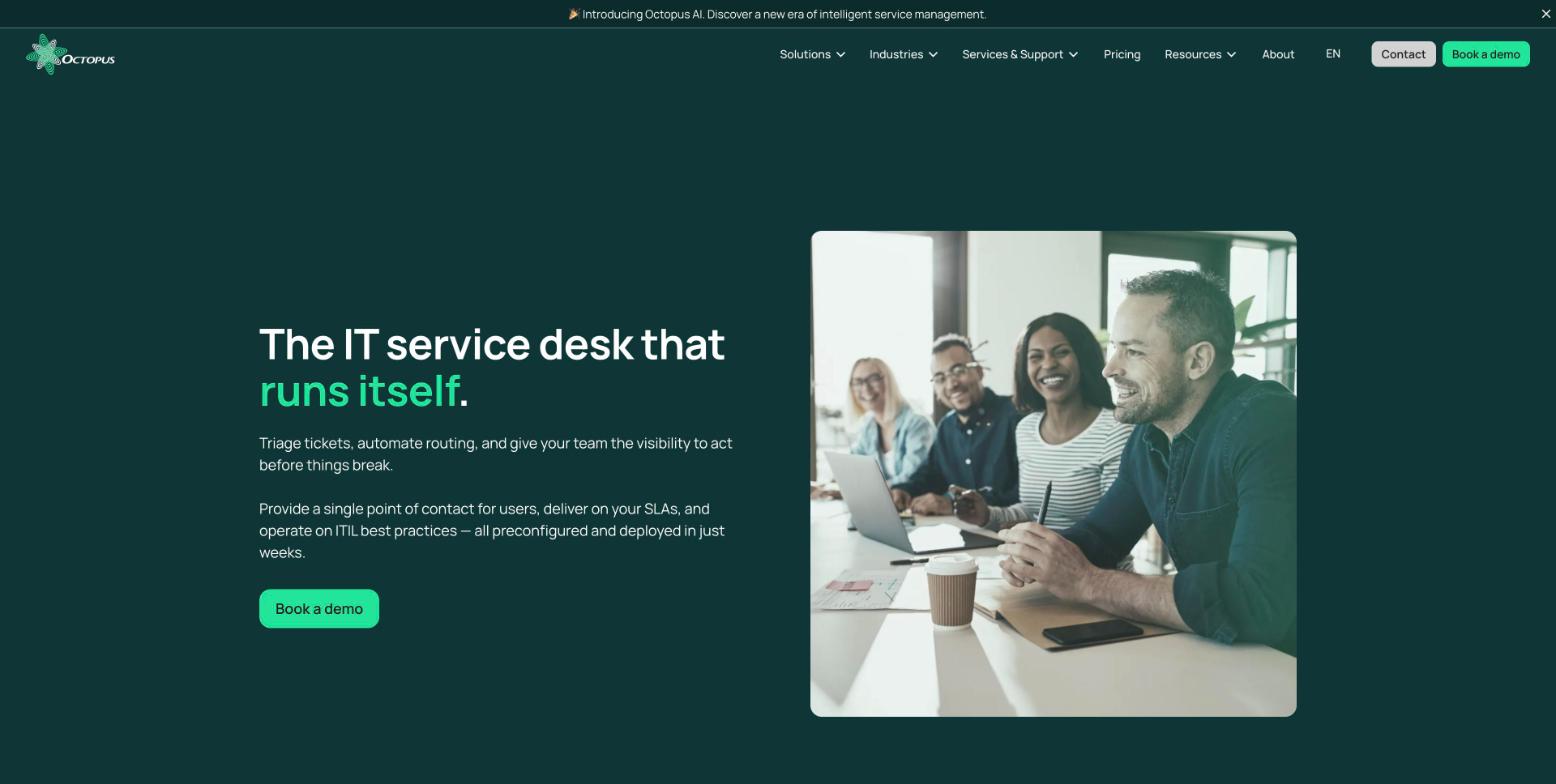
The best IT service management software for your organization is not necessarily the one with the most modules. To replace Freshservice, start by comparing what the AI actually does for your team, French-language support, hosting location, how much control you keep over your data and your team's ability to administer the platform. These criteria change the choice for a municipality, a CEGEP, a university, a healthcare institution or an SMB.
Freshservice remains a clear-cut cloud solution, but its price and features vary by tier. Freshservice currently lists Starter at US$19 per agent per month, Growth at US$49 per agent per month and Pro at US$99 per agent per month, each billed annually. Starter includes incident and knowledge management; Growth adds the service catalog, SLA management, on-call management and cloud management; Pro adds problem, change, major incident, workload and release management. Freddy AI Copilot is listed at US$29 per agent per month billed annually (Freshservice pricing). A relevant alternative should therefore be evaluated on real cost, but also on the organization's operational reality.
The criteria that matter
The right choice comes down to seven concrete criteria: AI, interface and support language, hosting, data control, ticket management, ITSM depth and administration effort.
| Criterion | Question to ask the vendor |
|---|---|
| AI | What does the AI actually do (configure, recommend, triage), who approves its output and is it included or an add-on? |
| French | Are the portal, support and documentation truly available in Canadian French? |
| Hosting | In which country and region is the data hosted? |
| Control | Can you export your data and manage your rules without depending on a development project? |
| Ticketing | Are requests received by email, portal and other channels centralized? |
| ITSM | Are incidents, requests, problems, changes, SLAs and assets linked together? |
| Administration | Who will evolve the forms, rules and reports after deployment? |
Law 25 modernized privacy legislation, including the Act respecting the protection of personal information in the private sector, and imposes obligations on organizations that collect, use and disclose personal information. The Commission d'accès à l'information du Québec outlines the main changes. Hosting does not replace a legal analysis, but it can simplify governance, discussions with stakeholders and contract review.
5 Freshservice alternatives to consider
The five options below are not ranked by global popularity. They are ranked by how well they fit distinct needs. Octopus ITSM comes first because the site publishing this guide offers it and because its AI Assistant and French-language support address two of the criteria above directly. The other options win in specific scenarios.
1. Octopus ITSM: AI-assisted ITSM with French-language support
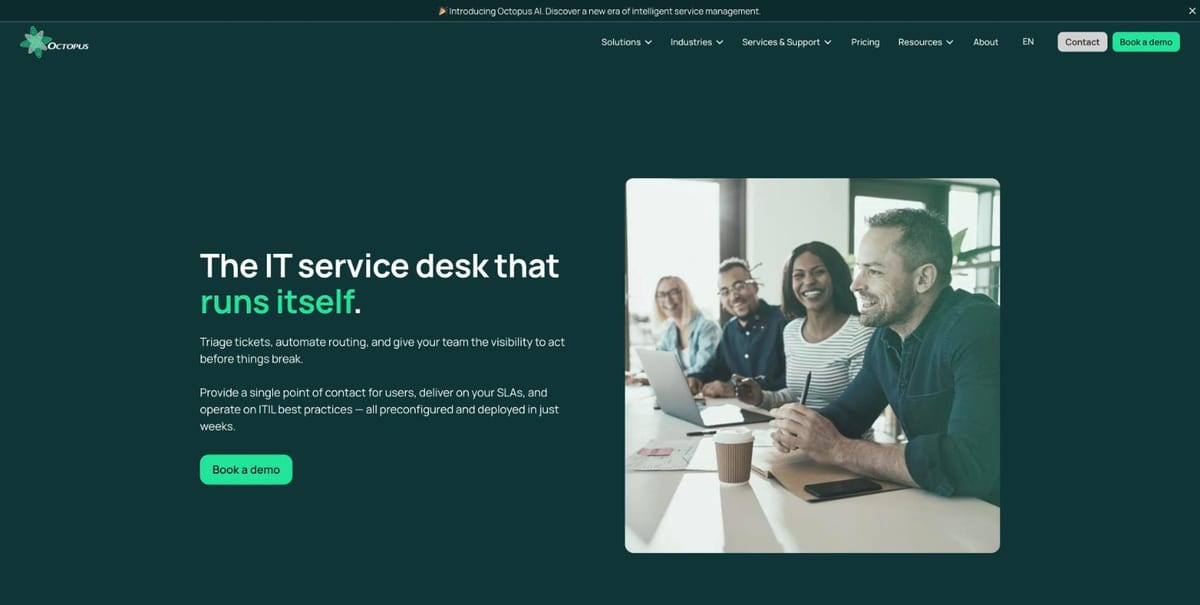
Octopus ITSM suits teams that want to centralize incidents, service requests, problems, changes, IT assets and ITIL processes behind a self-service portal. It comes preconfigured on ITIL best practices, and Octopus serves healthcare, education, municipalities, the public sector and SMBs.
Its biggest difference from Freshservice is the Octopus AI Assistant. Octopus describes three benefits:
- Configure and evolve the tool on your own. Describe the field, form or workflow you need and the AI Assistant builds it in real time, with no code and no developer. Your team adapts its processes as its needs change, without an outside expert.
- Proactive recommendations. It analyzes your service data in real time, spots gaps such as missing critical fields or incomplete inventories, and proposes concrete actions.
- Fewer repetitive tasks. It categorizes and routes requests, assigns tickets and detects recurring issues, so technicians focus on their priorities.
People stay in control: the AI Assistant proposes, your team accepts, adjusts or ignores. Compare what each AI does on your own tickets, not just its price.
Octopus also offers local, French-speaking technical support, and its cloud is hosted in Quebec, SOC 2 Type 2 certified and compliant with Law 25. The site cites more than 220 client organizations and more than 250,000 daily users (Octopus overview). These figures are published by the vendor, not an independent measurement.
- Best for: IT teams that want an AI Assistant to configure the tool and take on repetitive triage, a French-language portal and built-in ITIL processes.
- Limitation: Octopus publishes a price of $95 per active agent per month with an unlimited end-user portal (Octopus pricing). Request a proposal that covers the number of agents and any implementation or training services.
- Verify: contractual hosting commitments, required integrations and the exact scope of included support.
Octopus ITSM is also the starting point if the organization eventually wants to extend management to internal services, maintenance or biomedical equipment with Octopus ESM, Octopus CMMS or Octopus GBM.
2. WeITSM: an isolated instance for SMBs and municipalities
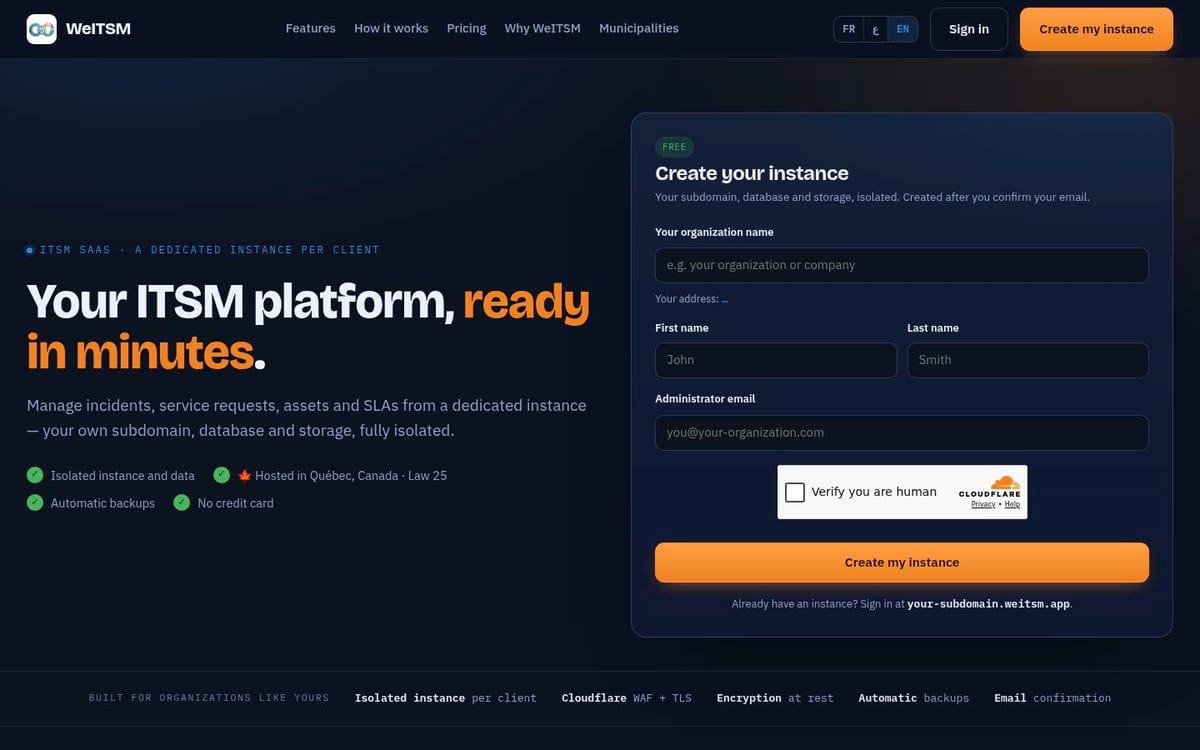
WeITSM targets SMBs and municipalities that want a SaaS ITSM with a dedicated instance. The vendor states that each client has its own subdomain, database and storage, hosted in Canada and designed for Law 25.
The platform covers incidents, service requests, the CMDB, assets with network discovery, SLAs, the knowledge base and dashboards. This positioning directly answers a question Freshservice does not always address publicly: where is the data, and who shares the environment?
- Best for: SMBs and municipalities that prioritize data isolation, a French-language interface and simple administration.
- Limitation: a more focused product; assess its integrations and partner ecosystem if your needs go beyond a standard IT service desk.
- Verify: available connectors, the disaster recovery plan, export terms and the level of support set out in the contract.
3. GLPI: the open source choice for keeping control

GLPI makes sense if your team wants to self-host its IT ticketing software and inventory. The project brings together tickets, assets, a CMDB, a self-service portal, SLAs, automations and a knowledge base. The self-hosted version is open source; GLPI Network Cloud adds a managed cloud service.
The open source model reduces dependence on a vendor and lets you keep control of hosting. It also shifts part of the responsibility to the organization: updates, security, backups, availability and Linux or PHP skills all have to be planned.
- Best for: teams with in-house skills, a self-hosting requirement or a limited licensing budget.
- Limitation: the tool is not an administration-free solution. Total cost of ownership includes the server, updates and team time.
- Verify: French-language support, the partner who would handle implementation and the data location if you choose the cloud.
GLPI states that its platform has existed for more than 20 years and has more than 10 million users worldwide (GLPI ticketing page). These figures come from GLPI and are not a quality certification for your deployment.
4. Jira Service Management: the choice for teams already on Atlassian
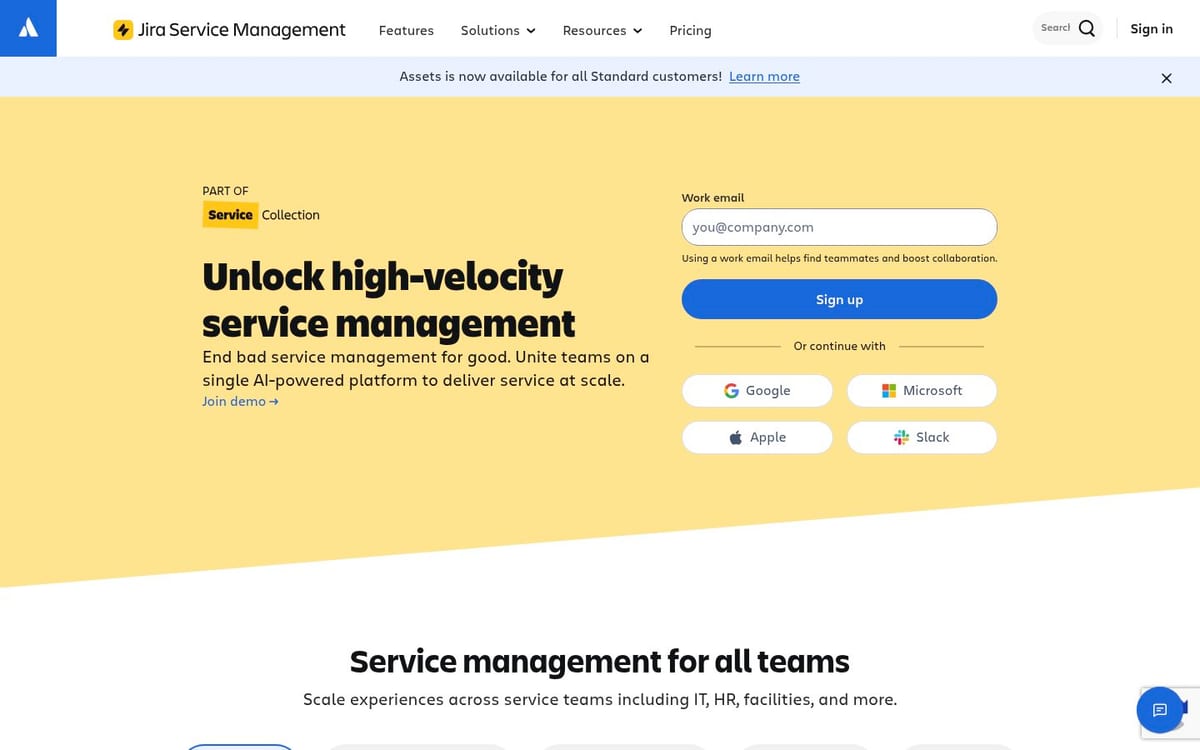
Jira Service Management is a logical alternative if your developers already work with Jira Software and Confluence. Tickets, changes, incidents and development work can stay in the same ecosystem.
Atlassian documents advanced features in Cloud Premium, including change management, advanced incident management, AIOps, assets and a 99.9% uptime guarantee (Jira Service Management Premium). Atlassian lists a Free plan for up to three agents, Standard at US$21.50 per agent per month and Premium at US$55.28 per agent per month. Enterprise is billed annually by quote, and the final total depends on your configuration and billing cycle.
- Best for: IT and DevOps teams already managed within the Atlassian ecosystem.
- Limitation: configuration requires Jira knowledge, and the cost of advanced tiers, users and add-on modules can climb quickly.
- Verify: the data residency region, French-language support coverage and the features available at the price tier you select.
5. ManageEngine ServiceDesk Plus: the choice for features versus deployment options
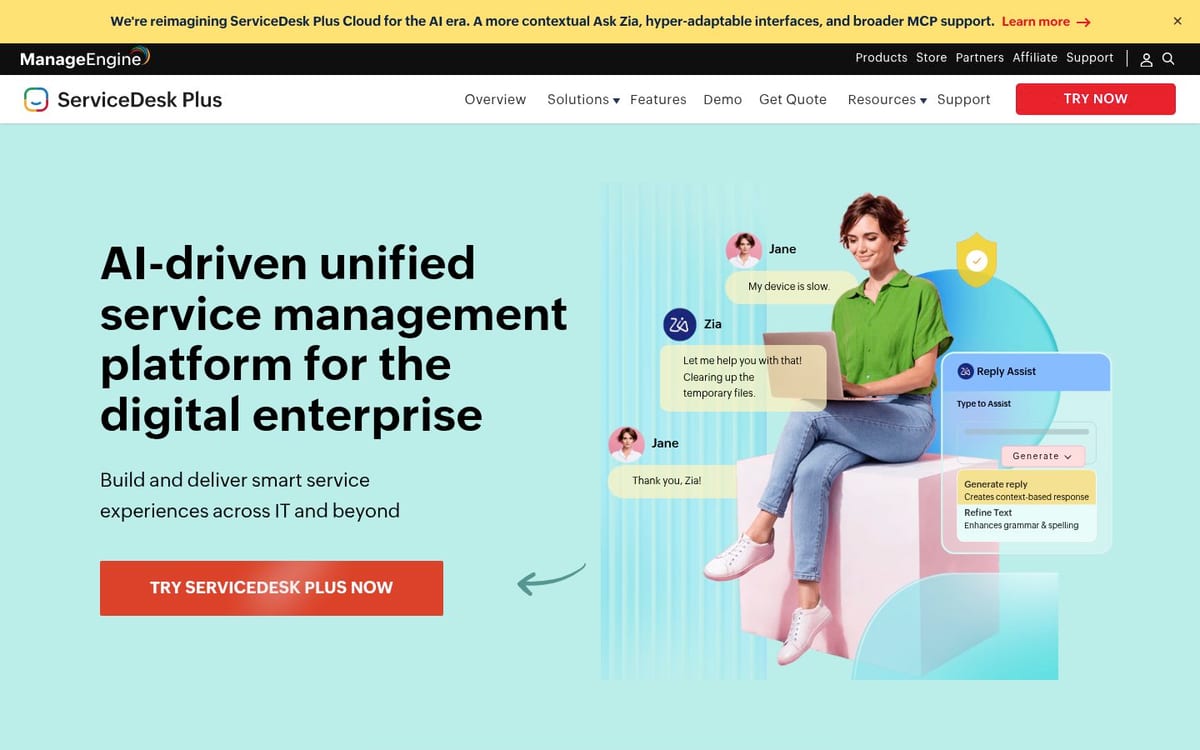
ManageEngine ServiceDesk Plus covers tickets, assets, the CMDB and ITSM practices in the cloud or on-premises. The official pricing page lists a free Standard edition for up to five technicians. On-premises editions start at US$13 per technician per month for Standard, US$27 for Professional and US$67 for Enterprise (ServiceDesk Plus pricing). Cloud prices and annual amounts vary with the number of technicians and assets.
This option suits organizations that want to compare cloud and on-premises, or that already work with other ManageEngine products. The downside is pricing that also depends on the number of assets for some editions.
- Best for: teams that want broad ITSM coverage, a choice between cloud and on-premises and a published starting price.
- Limitation: the edition you actually need can cost more than the entry price once assets and modules are factored in.
- Verify: the quality of French-language support, the location of cloud data and migration costs from Freshservice.
Which Freshservice alternative should you choose for your situation?
The best choice depends on the constraint that is pushing you to leave Freshservice.
| Your priority | Option to look at first | Why |
|---|---|---|
| An AI Assistant that configures the tool and handles triage, with French-language support | Octopus ITSM | Configuration by conversation, proactive recommendations, preconfigured ITIL processes and local French-speaking support |
| Isolated instance | WeITSM | Dedicated instance and local hosting announced by the vendor |
| Self-hosting and control of the code | GLPI | Open source version and choice of hosting |
| Integration with Jira and Confluence | Jira Service Management | Native Atlassian ecosystem |
| ITSM features with an on-premises option | ManageEngine ServiceDesk Plus | Cloud and on-premises, with published starting prices |
Don't compare only the price per agent. Add migration, assets, support, modules, AI add-ons, training, backups and administration time. A cheaper tool can end up costing more if your team has to rebuild processes, reports and integrations on its own.
How do you test a Freshservice alternative?
A pilot on real tickets gives a more reliable answer than a sales demo. Use a representative sample and record the time each step takes.
- Import a small history of anonymized tickets.
- Configure three incident categories, two service requests and one SLA.
- Test intake by email and by portal.
- Link at least one ticket to an asset or a user.
- Have someone who was not involved in the implementation modify a form.
- Check data export, audit logs and administrative roles.
- Ask the vendor to respond in French to an urgent support scenario.
- If the tool has AI, run it on your sample: what it categorizes, what it recommends and what a person still has to approve.
The test should measure adoption, not just the number of boxes checked. If employees don't understand the portal or technicians bypass the categories, the solution will not deliver the visibility you expect.
FAQ
What is the best Freshservice alternative?
Octopus ITSM is the first option to look at if you want an AI Assistant that configures the tool and takes on repetitive triage, with French-language support and sector experience. WeITSM, GLPI, Jira Service Management and ManageEngine win in different scenarios: a dedicated instance, open source control, Atlassian integration or an on-premises option.
How does the Octopus AI Assistant compare with Freddy AI Copilot?
Freddy AI Copilot is an add-on to Freshservice. The Octopus AI Assistant acts directly in the tool: you describe the field, form or workflow you need and it builds it without code, it recommends concrete actions from your service data, and it categorizes, routes and assigns requests while your team approves what it proposes. Test both on the same anonymized tickets before you decide.
Is Freshservice available in French?
Freshservice offers localization features and several portal languages, but coverage of support and documentation in Canadian French should be confirmed in the contract. A translated interface does not guarantee French-language support.
Which IT ticket management software offers hosting in Canada?
Octopus states that its data is hosted in Canada and that its platform complies with Law 25, and WeITSM states that each instance is hosted in Canada. GLPI can be hosted wherever your organization decides when self-hosted. Ask for contractual proof of the data region for any cloud solution.
Is GLPI a good Freshservice alternative?
Yes, if you have the skills needed to manage open source software and its infrastructure. GLPI covers ticketing and inventory, but the organization has to take on part of the operations that Freshservice delegates to the vendor.
Is Jira Service Management a good fit for a small IT team?
Yes, especially if the team already uses Jira Software or Confluence. For a team unfamiliar with Atlassian, configuration and the advanced tiers can require more administration than a tool designed for a standalone service desk.
How much does ManageEngine ServiceDesk Plus cost?
ManageEngine lists a free Standard edition for up to five technicians. On-premises pricing starts at US$13 per technician per month for Standard, US$27 for Professional and US$67 for Enterprise, but the number of assets and the edition you choose affect the total.
Sources and references
- Freshservice, official pricing: plans, modules and reference prices.
- Octopus ITSM: ITSM processes, portal, automation and governance.
- Octopus, AI Assistant: benefits and human control.
- Octopus, pricing: price per active agent, hosting and French-speaking support.
- Octopus overview: figures published by the vendor.
- WeITSM, about: dedicated instance and local hosting as announced.
- GLPI, ticketing tool: ticketing, open source and inventory.
- Jira Service Management Premium: advanced features and SLA.
- ManageEngine, pricing: editions, prices and license limits.
- Commission d'accès à l'information du Québec: changes related to Law 25.
Also to be read
Explore more articles on incident management and ITSM best practices.