
IT Service Management Software: 4 Jira Alternatives

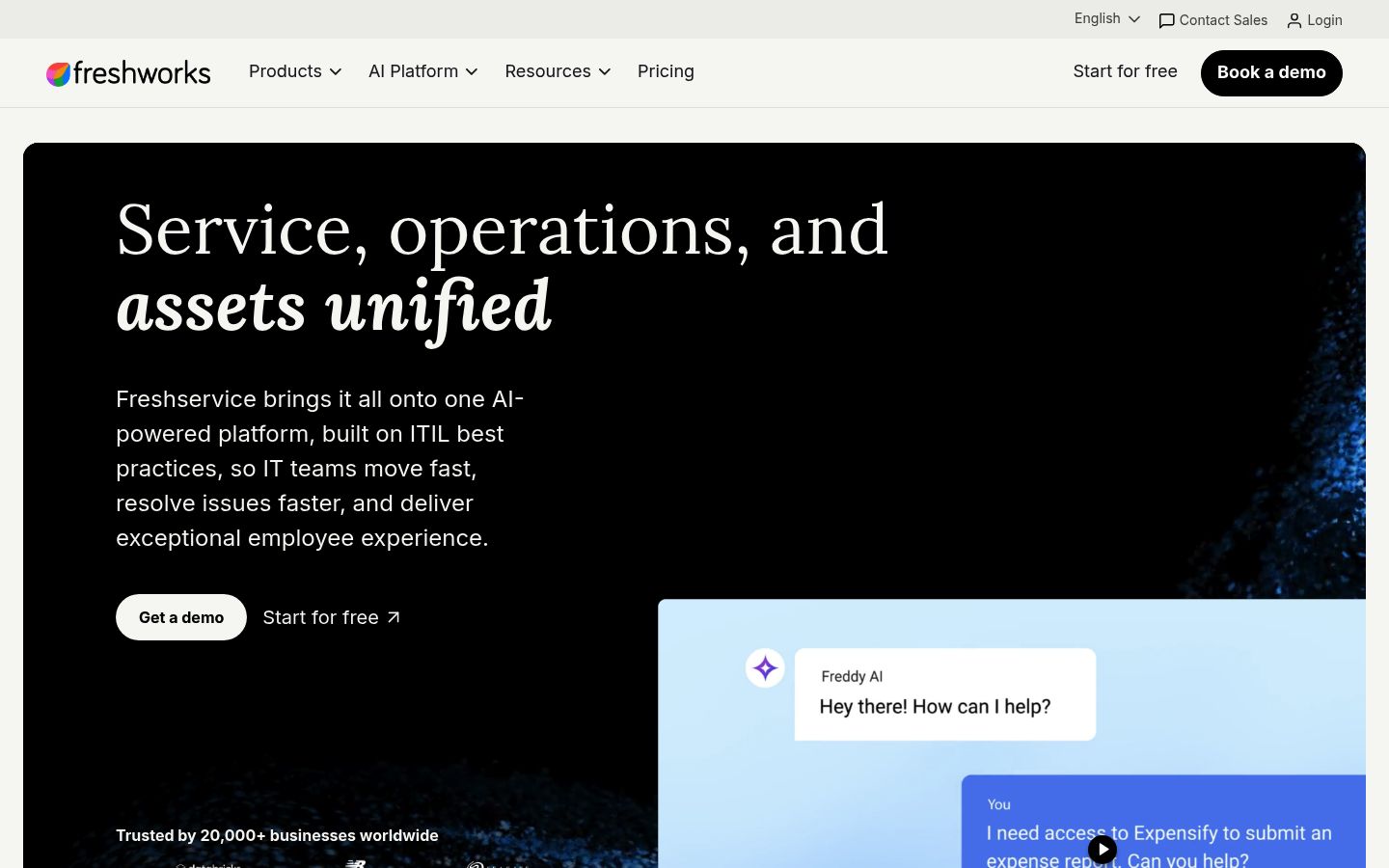
If Jira Service Management no longer fits your service desk, the strongest alternatives are Freshservice for a fast cloud rollout, ServiceNow for large-scale governance, ManageEngine ServiceDesk Plus for deployment choice and asset depth, and Octopus ITSM for Canadian support and industry-specific service management.
Your decision should turn on more than ticketing: compare migration effort, administration, French-language support, data location, and the budget model your team can defend.
Jira Service Management remains a sensible choice when your service desk must stay close to Jira Software, Confluence, and Atlassian workflows. An alternative makes more sense when that ecosystem creates too much dependency, your service desk needs a different operating model, or your organization wants a broader internal-services platform.
The four alternatives at a glance
The best choice depends on the constraint that is hardest for your team to change. Freshservice leads on public, easy-to-compare cloud pricing. ServiceNow is built for organizations that need a large enterprise platform and can work through a sales process.
ManageEngine gives you cloud and on-premises deployment options. Octopus ITSM fits teams that want a per-active-agent model, local support, and a path from ITSM to other internal services.
| Alternative | Best fit | Published starting price | Administration and deployment | Main limitation |
|---|---|---|---|---|
| Freshservice | Cloud-first teams that want a quick start | $19 USD per agent per month, billed annually | Cloud platform with ITSM, asset, operations, and ESM capabilities | Higher tiers and AI can change the total cost |
| ServiceNow | Large organizations with complex governance | Not published on the product page | Enterprise platform with a sales-led buying process | Budget and implementation scope need a quote |
| ManageEngine ServiceDesk Plus | Teams comparing cloud with on-premises control | US$1,545 per year for 10 cloud technicians on Standard | Cloud or on-premises, with ITSM, ITAM, and CMDB options | Asset-based pricing adds another variable |
| Octopus ITSM | Canadian teams that need local support and sector context | $95 per active agent per month | Preconfigured ITIL processes, no-code configuration, and Canadian hosting | AI Assistant and implementation services are separate considerations |
Prices were checked on November 9, 2026. Currency, billing period, technician or agent definition, asset count, implementation, and optional modules can change the total. Treat the table as a shortlist, not a quote.
Freshservice: the practical cloud-first alternative
Freshservice is the clearest Jira Service Management alternative when you want a cloud ITSM platform with a public price page and a short path to core service-desk work. Its published Starter plan is $19 USD per agent per month, billed annually.
The page lists incident management, knowledge management, task management, and a support portal in that plan.
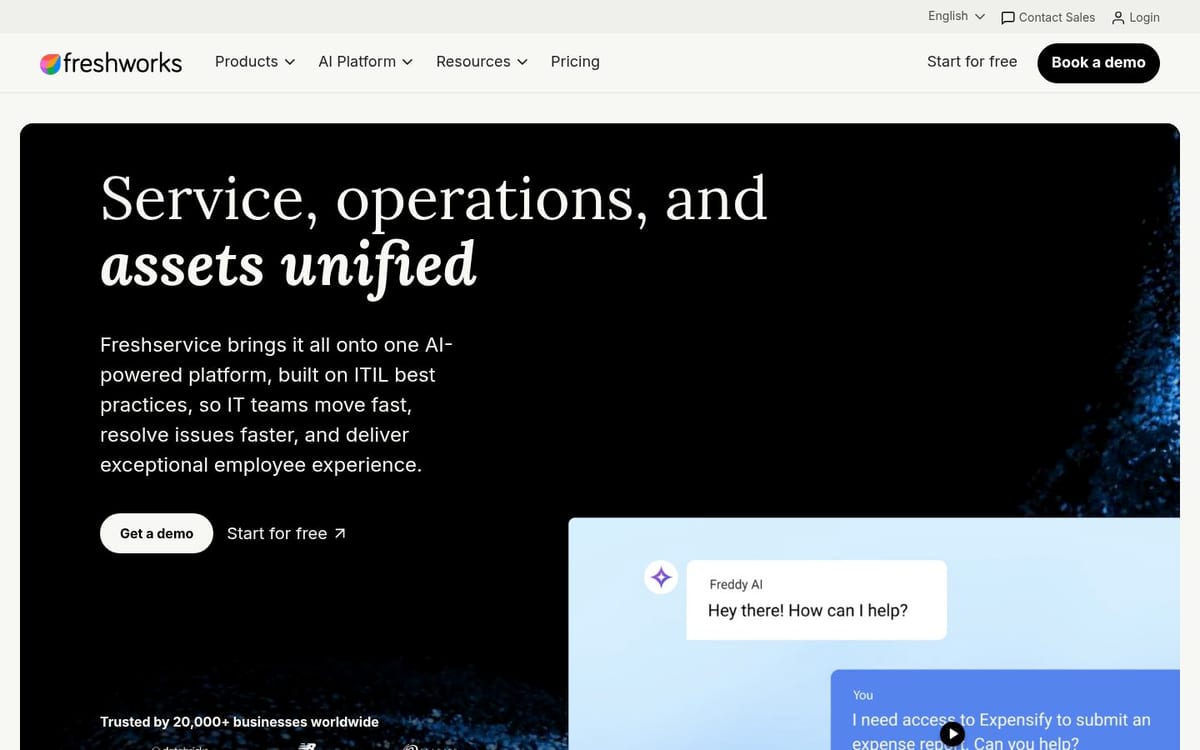
Freshservice is a good fit if your priorities are a conventional cloud service desk, service catalog, SLA management, and a familiar growth path. Its pricing page lists Growth at $49 USD per agent per month, billed annually, with service catalog, SLA management, on-call management, and cloud management.
Pro is listed at $99 USD per agent per month, billed annually, and adds problem, change, major incident, workload, and release management.
The tradeoff is price complexity as your needs grow. The same page lists Freddy AI Copilot as a $29 USD per agent per month add-on. You also need to check the cost of asset units, advanced service operations, and the tier required for controls such as sandbox and audit logs.
Best for: Cloud-first IT teams that want public pricing, a standard ITSM feature path, and a broad marketplace.
Limitation: You can start simply, but the bill can become less simple as you add AI, asset, operations, and enterprise capabilities.
ServiceNow: the enterprise governance option
ServiceNow is the Jira Service Management alternative to examine when service management crosses several departments, regions, or control requirements. Its IT Service Management product page describes AI-assisted request fulfilment, incident prevention, change automation, knowledge connections, and support across IT and business teams.
ServiceNow is stronger when you need a platform conversation rather than a small-team help desk decision. Ask about CMDB scope, asset relationships, change governance, employee workflows, data residency, integrations, implementation partners, and who will own administration after launch.
The price is not published on the product page, so budget discovery is part of the buying process. That is not automatically a reason to reject it. It is a reason to define your scope before comparing a quote with per-agent plans. Include implementation, integration, training, ongoing administration, and the cost of extending the platform beyond IT.
Best for: Large organizations with mature governance, multiple service domains, and the capacity to run an enterprise implementation.
Limitation: Buyers cannot use a public entry price to create a reliable first-pass budget. The sales process and implementation scope matter early.
ManageEngine ServiceDesk Plus: deployment choice and asset context
ManageEngine ServiceDesk Plus is the strongest option here when deployment control and asset context matter as much as the service desk. Its official product page describes ITSM, IT asset management, CMDB, enterprise service management, low-code customization, and both cloud and on-premises deployment.
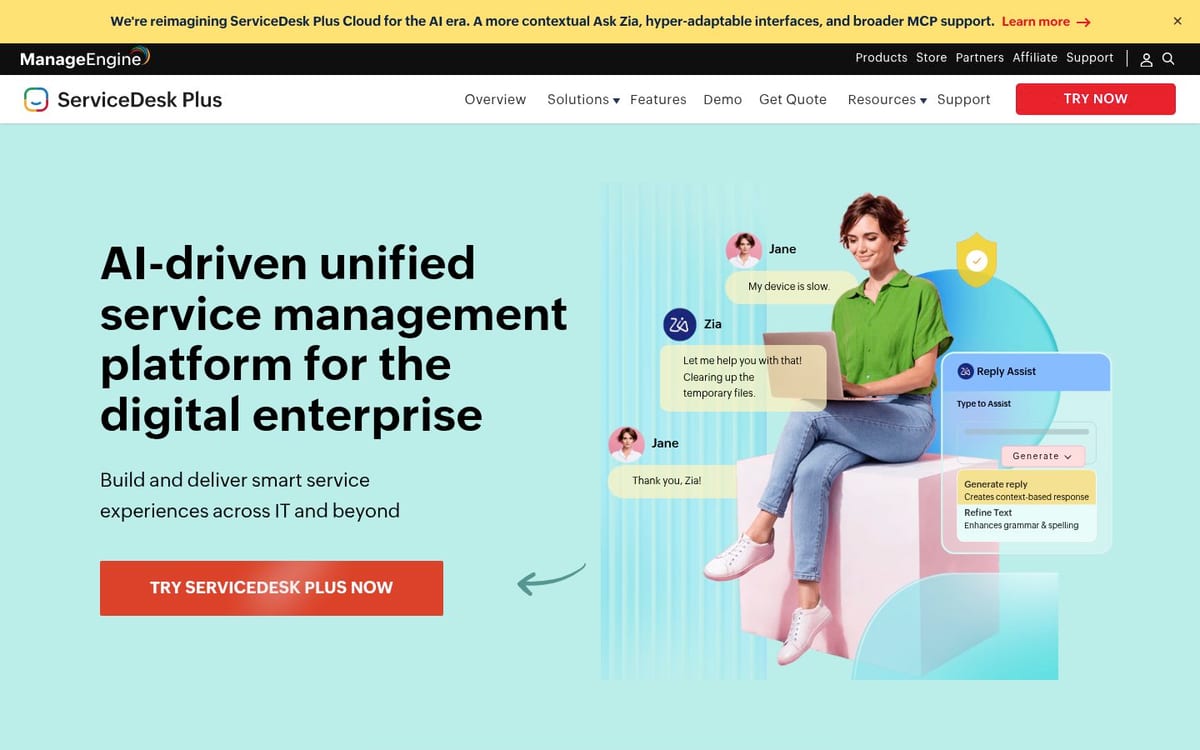
The pricing model needs careful reading. ManageEngine's pricing page lists the cloud Standard edition at US$1,545 per year for 10 technicians.
It lists Professional at US$645 per year for two technicians and 250 assets, and Enterprise at US$1,595 per year for two technicians and 250 assets. The page says these prices were current as of September 2026.
The product page says Standard focuses on the service desk, Professional adds IT asset management, and Enterprise adds service catalog, problem, change, release, project management, and CMDB capabilities. ManageEngine also says ServiceDesk Plus is available on-premises. That flexibility can help organizations with infrastructure or data-control requirements, but it puts more responsibility on your team when you choose self-hosting.
Best for: Teams that want ITSM and asset management with a choice between cloud and on-premises deployment.
Limitation: You need to model technicians and IT assets together. A low service-desk entry price does not represent every implementation.
Octopus ITSM: local support and sector-ready configuration
Octopus ITSM is the most relevant Jira Service Management alternative when Canadian context, French-language support, and autonomy in configuration are central to the decision. The English Octopus ITSM page describes incident, request, problem, change, CMDB, service catalog, workflow, reporting, and enterprise service management capabilities.
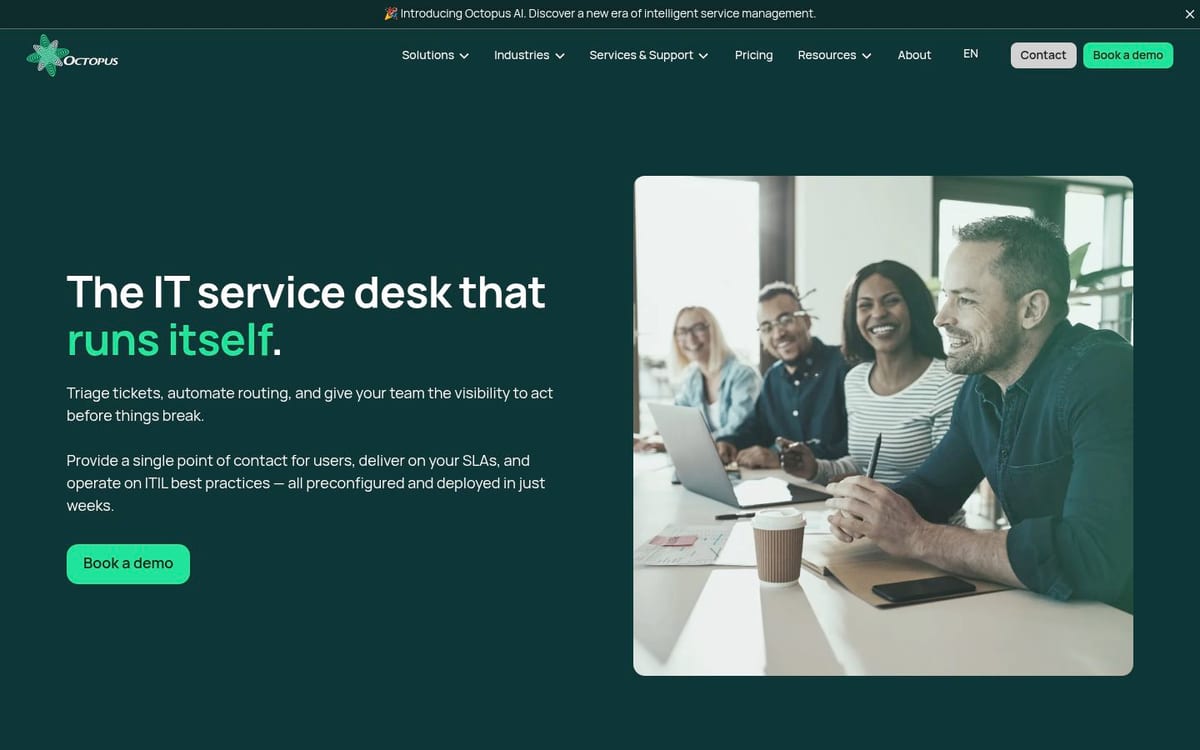
Octopus publishes $95 per active agent per month. Its pricing page lists technical support and an unlimited web portal for end users among the subscription inclusions.
The same page gives a five-agent example of $5,700 per year before taxes. That arithmetic is 5 agents x $95 x 12 months.
The differentiator is not just the price. Octopus describes preconfigured ITIL processes, no-code configuration, data hosted in Canada, and support from Canada. The AI Assistant page says the assistant can help configure fields, forms, and workflows, analyze operational data, identify gaps, and reduce repetitive routing work. Teams keep control of proposed changes.
The limitation is equally important: confirm how the AI Assistant, implementation, and training affect the full project cost. Octopus is a better fit when your buyer values local context and autonomy. It is not the obvious choice for a team that only wants to reproduce a Jira-centric developer workflow.
Best for: Canadian organizations, public-sector and healthcare teams, and service desks that need local support, ITIL processes, and room to extend into ESM.
Limitation: You need a conversation about the AI Assistant and implementation services before you can compare the full cost with a basic per-agent subscription.
Which alternative supports French-language service teams?
Octopus is the clearest option to investigate first if French-language support and Quebec context are buying requirements. Its support and pricing pages describe local technical support in French, while the other vendors' public pages do not establish the same local support model in the material reviewed here.
That does not mean the other platforms cannot support French-speaking users. Ask each vendor to show the agent interface, employee portal, knowledge base, documentation, training, escalation process, and support channel in the language your team will use. Language coverage in a user interface is not the same as service from a French-speaking support team.
How to compare migration from Jira Service Management
Migration risk comes from process and data, not just ticket export. Before selecting an alternative, inventory your request types, queues, SLAs, automations, knowledge articles, assets, approvals, integrations, reports, and Jira project links.
Use a small pilot with three real workflows: a standard service request, a priority incident, and a change that needs approval. Measure how much configuration your own administrators can complete, how much historical data imports cleanly, how users find the portal, and how the vendor handles an exception.
Pay special attention to Jira dependencies. If developers need tickets to stay connected to software work, validate the integration before you sign. If the service desk has become a general internal-services hub, compare ESM, asset context, language support, and administration instead of reproducing every Jira workflow by default.
Bottom line: choose by the constraint you cannot ignore
Choose Freshservice when a cloud-first team wants transparent entry pricing and a conventional ITSM path. Choose ServiceNow when enterprise governance and scale justify a sales-led platform decision. Choose ManageEngine ServiceDesk Plus when cloud or on-premises control and asset pricing need to be weighed together. Choose Octopus ITSM when Canadian support, French-language service, sector context, and configuration autonomy are central.
The right Jira Service Management alternative is the one your team can operate after the migration. Ask each finalist to demonstrate the same three workflows, show the full cost for your agent and asset count, and explain who owns changes after launch.
Frequently asked questions
What is the best Jira Service Management alternative for a small IT team?
Freshservice is the easiest first comparison for a small team that wants a cloud service desk and public pricing. ManageEngine ServiceDesk Plus is also worth testing if a free or lower-cost Standard path, asset context, or on-premises deployment matters. The better choice depends on whether your team values a simple cloud rollout or deployment flexibility.
Which Jira Service Management alternative has on-premises deployment?
ManageEngine ServiceDesk Plus explicitly publishes cloud and on-premises deployment options on its product and pricing pages. ServiceNow and Freshservice should be assessed against your current hosting and data requirements through their sales or technical teams. Confirm the deployment model, upgrade responsibility, backup process, and integration limits in writing.
Which IT service management software has public pricing?
Freshservice and Octopus publish clear per-agent prices on their pricing pages. ManageEngine publishes cloud and on-premises prices, with technician and asset variables. ServiceNow does not publish a starting price on the product page reviewed here, so you need a scoped quote that includes implementation and administration.
Is Octopus ITSM a good alternative to Jira Service Management?
Octopus ITSM fits organizations that want ITIL-based service management, Canadian hosting and support, sector-ready configuration, and a path from ITSM to ESM. Its AI Assistant can help configure workflows, analyze service data, and reduce repetitive routing work. It is less suited to a team whose main requirement is tight alignment with Jira Software development work.
How much does Freshservice cost compared with Octopus ITSM?
Freshservice lists Starter at $19 USD per agent per month billed annually, while Octopus lists $95 per active agent per month. The figures are not a complete total-cost comparison: Freshservice has higher plans and AI-related charges, while Octopus asks buyers to confirm the full project scope. Check currency, taxes, modules, and agent definitions.
What should I test before switching from Jira Service Management?
Test one service request, one priority incident, and one approved change with real data. Check imports, SLAs, automations, asset relationships, portal adoption, reporting, integrations, and administrator effort. Ask for the five-year cost, migration responsibilities, support language, data location, and the process for changing workflows after launch.
Sources and references
- Freshservice pricing, checked November 9, 2026: plans, prices, billing, features, and AI add-on.
- ServiceNow IT Service Management, checked November 9, 2026: enterprise ITSM capabilities and quote-based pricing context.
- ManageEngine ServiceDesk Plus, checked November 9, 2026: deployment models, ITSM, ITAM, CMDB, and ESM capabilities.
- ManageEngine pricing, checked November 9, 2026: cloud and on-premises prices and pricing variables.
- Octopus ITSM, checked November 9, 2026: ITSM features, Canadian context, and configuration model.
- Octopus pricing, checked November 9, 2026: active-agent price, included services, and example budget.
- Octopus AI Assistant, checked November 9, 2026: conversational configuration, recommendations, and repetitive-task support.
Also to be read
Explore more articles on incident management and ITSM best practices.